
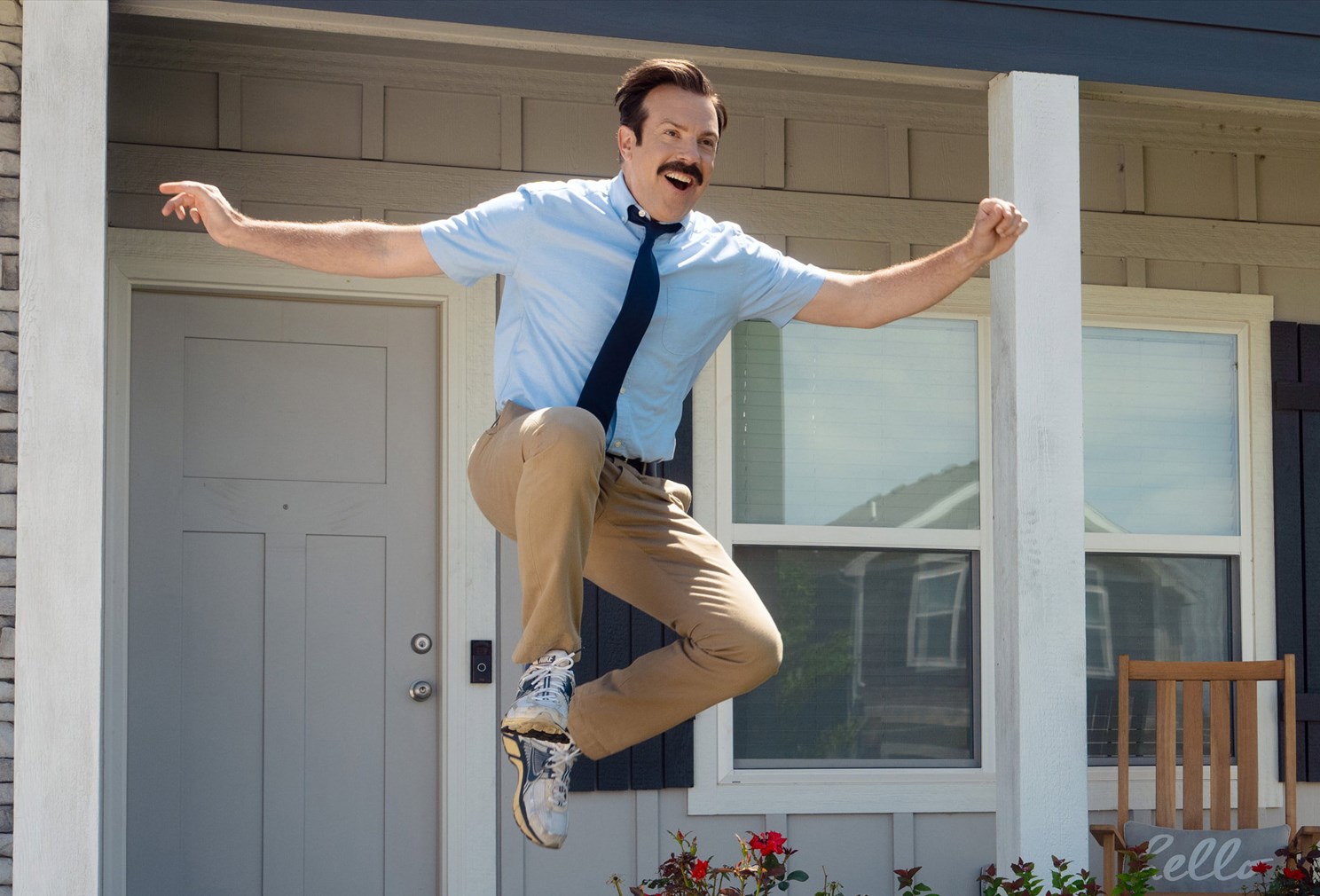
The last image of “Ted Lasso” anybody had for three years was a man on a plane, folding a paper airplane and letting Richmond go. Season 4 opens on the sequel to that shot, and it is a name tag. Ted Lasso (Jason Sudeikis) is working the floor of an upscale Kansas City grocery store, greeting customers, talking produce, and looking about as settled as a man can look while doing none of the thing he is spectacular at. It is a terrific joke, and the premiere is never quite sure what to do with it.
“Home” arrived Wednesday on Apple TV, the first of ten episodes rolling out weekly through October 7, and it spends forty-odd minutes setting up a genuinely fresh hook. Ted is coming back to Richmond, just not to the men’s side. Rebecca wants him for the club’s new second-division women’s team, the Lady Greyhounds. That is a smart place to restart a show that had already given its lead a clean, finished ending, and it sidesteps the obvious trap of running the same promotion story twice. Whether this particular episode earns that premise is the argument the whole internet is having today. Warning beyond this point there are spoilers for “Ted Lasso” Season 4 and the full ending of the premiere episode “Home.”
Season 4 opens on the sequel to that shot, and it is a name tag.”
The cold open does the heavy lifting on where Ted has landed. He is behind the counter, bright and chatty and completely unbothered, and when a former player, Joe Conrad (James Earl), turns up with his wife to tell him what he meant to them, Ted deflects it into a bit about the job being part-time and making up for lost time with his son. Sudeikis plays the whole scene with his shoulders down. That is the tell. Everyone around him keeps handing him the compliment and he keeps setting it back on the shelf, and the show is smart enough to let you notice the gap between what this man is and what he is currently doing at eleven in the morning on a Tuesday.
Then he gets pulled out of a shift to sit in a meeting at Henry’s school with his ex-wife Michelle (Andrea Anders), over a non-issue involving some Public Enemy lyrics copied into a notebook. It is a small scene with one telling beat buried in it: Ted spends most of it watching kids play football through the window. Henry is twelve now and recast, Grant Feely takes over the part, which is the kind of change that reads as necessary on paper and slightly disorienting on screen, because the show is asking us to feel the weight of a father-son bond using a face we have not spent three seasons with. It mostly works. It does not entirely.
The cavalry shows up in a black car in the suburbs: Rebecca Welton (Hannah Waddingham), Keeley Jones (Juno Temple) and Leslie Higgins (Jeremy Swift), the last of whom makes his entrance in sneakers and tall socks and immediately gets the biggest laugh of the episode. Here is where the premiere’s central gag reveals itself: this is the Season 1 fish-out-of-water setup with the polarity flipped. Now it is the Brits blinking at American portions, American phrases, American everything. It is a fun idea for about ten minutes. It is also the moment you realize the episode plans to lean on it for the entire runtime.


Over Kansas City barbecue the three of them catch up with Ted, and the show does its usual pleasant, low-stakes drift: Keeley talks kits and sponsorship for the new team, Higgins volunteers something about new bathroom flooring, and Rebecca mentions she is dating Matthijs (Matteo van der Grijn), the Dutchman from the end of Season 3. Then comes the actual ask. Rebecca does not pitch tactics or a league table. She wants Ted because of what he built in that clubhouse, the culture, the room, the thing nobody can put on a whiteboard, and she wants it for a second-division women’s side starting from nothing. It is the best-written moment in the episode and Waddingham lands it without pushing. Ted asks for time.
What follows is the part that actually got to us: a garage sale at Ted’s childhood home, where his mother Dottie (Becky Ann Baker) sells off the furniture and asks her son, more or less directly, why he does not care about his job. Baker has maybe eight minutes in this episode and she uses all of them. There is no speech, no swelling music, just a mother refusing to accept a contented shrug from a man she raised. If the season is going to be about anything, the ninety seconds in that garage are where it lives.
And then Ted says no. The airport goodbye is a genuinely deflating scene by design: he turns the job down, the London three head for their gate, and Rebecca presses a tea bag into his hand with a note reading “Ted, Let It Steep.” Her parting line is the episode’s thesis and its title in one go: sometimes home is just a state of mind. It is a lovely beat. It is also, if you are counting, the first real story development at roughly the thirty-five minute mark of a forty-two minute episode.

The close pulls it back. Ted goes home, and the camera finds what he has been living inside all along, a bedroom of AFC Richmond photos and memorabilia, a shrine to a life he keeps insisting he is fine without. He texts Michelle to ask whether she and Henry would ever consider moving to London. Henry, who has his mother’s phone, fires back an enthusiastic yes. Ted takes a sip of Rebecca’s tea and spits it straight out, which is exactly the note this show likes to end on. Here is our problem with it, and it is the same one the AV Club had when it handed the premiere a C-minus: the single biggest development in the episode, an ex-wife and a son agreeing to relocate to another continent, happens off screen, in a text message, in the last ninety seconds. That is a season’s worth of family negotiation resolved by emoji.
The other absence is louder. Roy Kent (Brett Goldstein) is not in this episode. Neither is Coach Beard (Brendan Hunt), nor Jamie Tartt (Phil Dunster), nor Nate (Nick Mohammed). Trent Crimm turns up as a newspaper clipping. That is a defensible choice for a premiere that is structurally about Ted being away from all of it, but it also means the show spent its return episode on three characters and a premise, and the reunion everybody actually tuned in for is still sitting in a drawer. A new intake is coming, with Tanya Reynolds, Faye Marsay, Abbie Hern, Jude Mack, Rex Hayes and Aisling Sharkey all joining, and none of them are in this one either.
So where does that leave it? Variety split the difference and called Season 4 both a promising reboot and a tedious sequel, which is about right for what is on screen here. The premise is strong. The women’s-team angle gives this show something to say that it has not already said, and Rebecca’s pitch, culture first, results later, is the exact argument that made the first season work. The execution is another matter. “Home” is forty-two minutes of a man deciding to do the thing the trailers told us he would do, and it gets there by mirroring Season 1 beat for beat with the accents swapped. Our honest read: this is a table-setting episode, and table-setting episodes are the worst possible way to judge a season. Ask us again in three weeks, when there is a team on the pitch.
What Do You Think? Was flipping the fish-out-of-water joke so the Brits are the confused ones a clever inversion or the clearest sign yet that this show is running its old plays back? Does keeping Roy, Beard and Jamie entirely off screen in a comeback premiere build anticipation, or did it waste the one episode guaranteed to have everybody watching? And here is the one we keep going back and forth on: was Michelle agreeing to move Henry to London in a text message a merciful shortcut past a story this show did not want to tell, or the exact kind of shortcut that got Season 3 in trouble?
See you on the next binge!