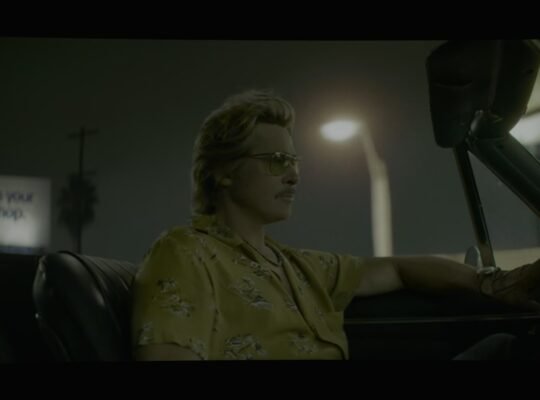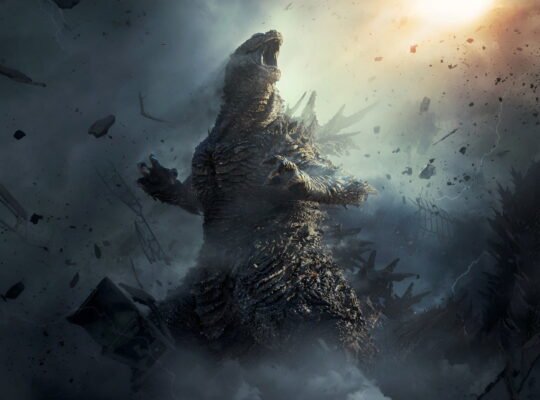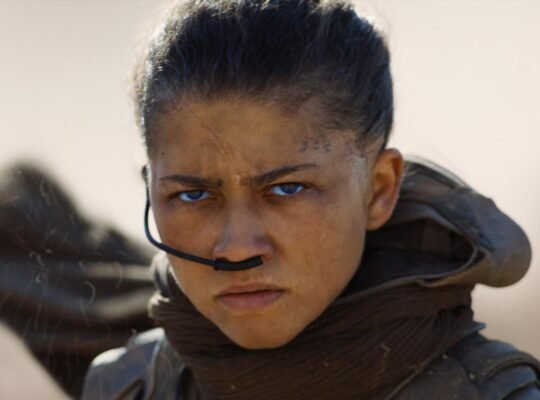
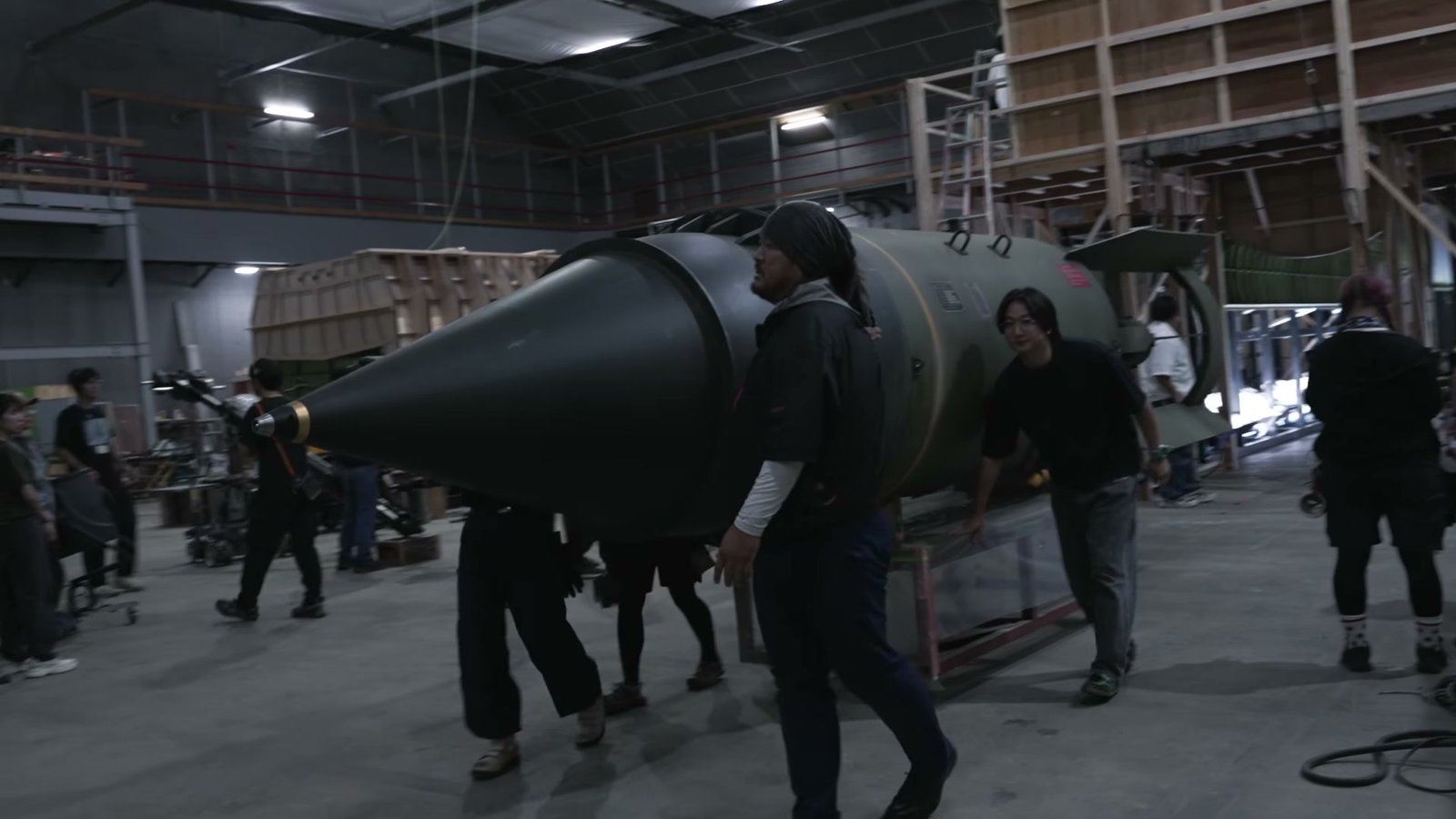
Two minutes of new footage went up on Toho’s own Godzilla channel on Tuesday, and there is not a single monster in it. It is a work reel. Cranes, scaffolding, a fire burning on a stage with a crew member hosing it down just outside the frame, a bomb the length of a small car being walked across a warehouse floor by six people who look like they have done it before. “Godzilla Minus Zero” opens in North America on November 6, and the first real look inside it is not a trailer at all. It is Toho showing you the workshop.
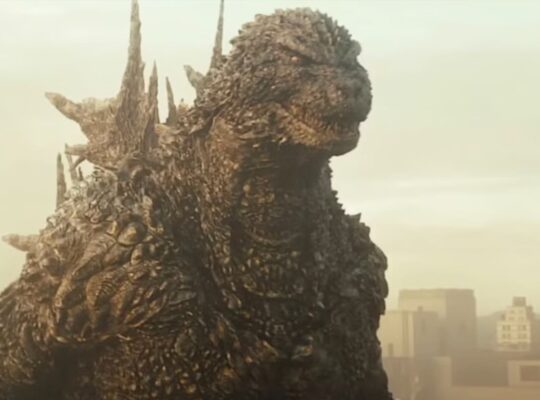
The clip is called “Behind the Camera,” it runs two minutes and three seconds, and it opens with a small piece of theatre. A brushed G fills the screen, the words MINUS ONE write themselves alongside it, and then they fall away and MINUS ZERO takes their place. Before that there is a card reading 2023 and a line reading ACADEMY AWARD Winner Best Visual Effects, laid over a shot of dorsal fins sliding past a building. The sequel introduces itself by standing on the shoulders of the last one, which is fair enough, because the last one is the reason anybody is watching. Warning beyond this point there are spoilers for “Godzilla Minus Zero,” including a costume detail in this footage that points at where the sequel finds one of its returning leads.
Cranes, scaffolding, a fire burning on a stage with a crew member hosing it down just outside the frame, a bomb the length of a small car being walked across a warehouse floor by six people who look like they have done it before.”
The first voice you hear belongs to the director. Takashi Yamazaki turns up at forty one seconds, headphones on, dark glasses, a monitor in front of him, and the subtitle reads “Ready, set…action!” After that the reel simply starts handing you the set. A soundstage the size of an aircraft hangar with a half finished build sitting in the middle of it under blue tarps. A period street at night with crew hauling gear through the dark. Extras in wartime clothing lying bloodied on tarpaulins in what is plainly a shelter or a field ward. A camera operator carrying a shoulder rig up a stairwell. None of it is glamorous. It is the version of a film set that looks like a building site, which is what a film set mostly is.
At fifty seconds the reel does something you almost never see in Western behind the scenes material. Yamazaki is standing at a small Shinto altar built on the stage floor, a red and white curtain strung behind it, fruit and vegetables laid out as offerings, and he claps twice and bows. The next shot is the crew, several hundred of them, bowed in the same direction with their backs to camera. That is the safety prayer that opens a Japanese production, and Toho left it in rather than cutting to something louder. It sits three seconds before a crane hoisting a scaffolded building section into the air on an outdoor lot, which is a blunt way of saying we asked for protection and then we started lifting heavy things over people’s heads.
The credit card that comes up over Yamazaki reads “VFX, Written, and Directed by Takashi Yamazaki,” and that is not a flourish, it is the whole reason this reel is worth two minutes of your time. The man who wrote it and directed it also runs its visual effects, and his last one took the Academy Award for Best Visual Effects while costing a fraction of what the films it beat spent on their vendors. Speaking into a microphone to the assembled crew, he says “I believe this team can create something greater than the last film.” A little later, over a shot of two actors on a street set with blue screen behind them, he adds “By doing things we’ve never done before and taking on new challenges… we can put everything into this film.”
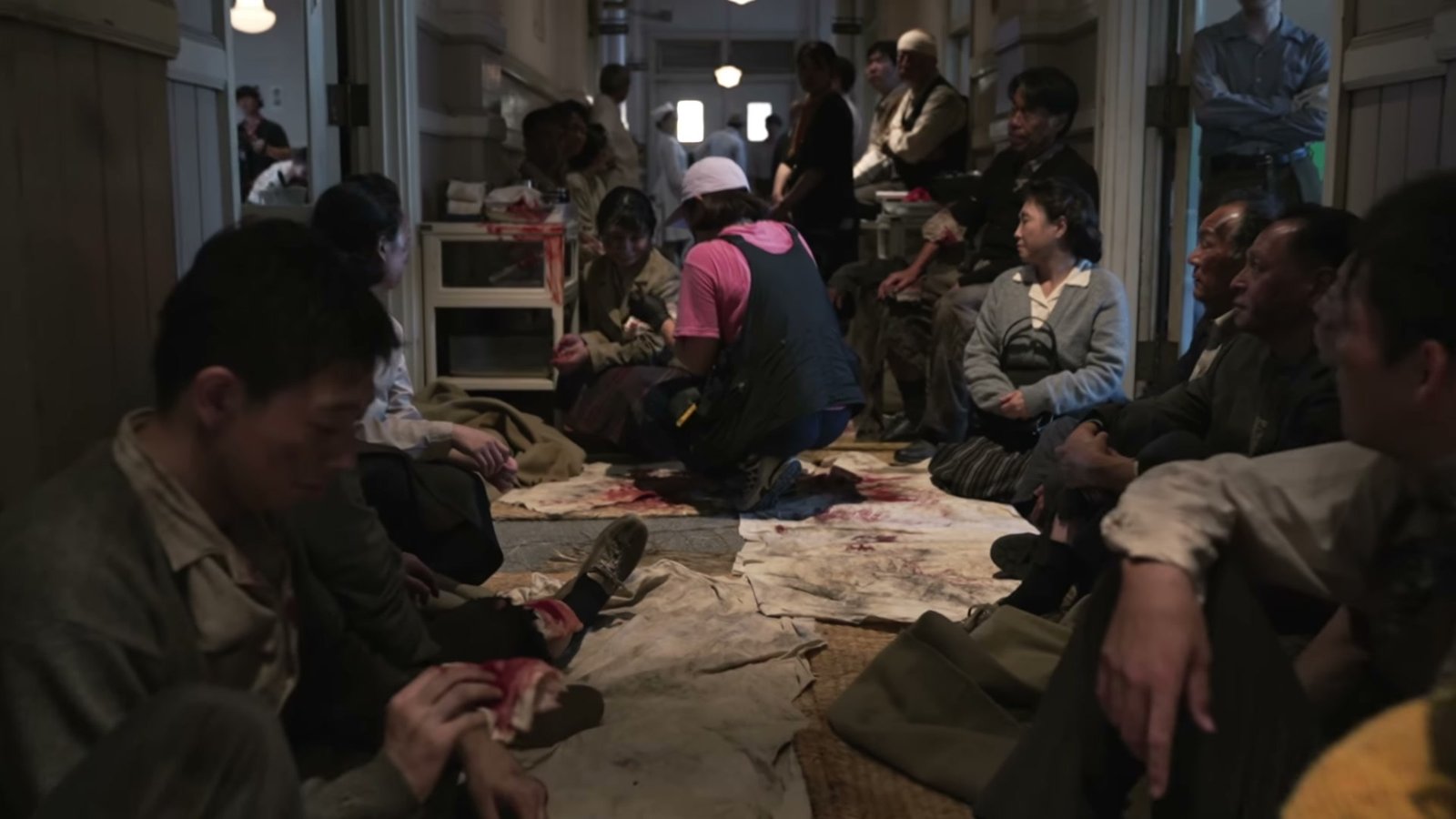
Here is the part worth slowing down for. A visual effects supervisor who is also the director could shoot this entire film on a green stage and paint the rest in later, and nobody would blink. Some of it plainly is on a green stage. There is a cyclorama big enough that a camera crane sweeps across it in one shot. There is a marquee tent with green drapes hung inside. At one minute forty two there is a crowd of extras running flat out across a green floor while crew scatter out of frame, which is a Godzilla panic being shot the only way a Godzilla panic can be shot. But a startling amount of what this reel shows is real, heavy, and sitting on the ground.
The list, in the order it appears: a fire burning on a practical set with the camera close enough to feel it. A scaffolded building lifted by a crane in daylight. A field of rubble and charred timber spread across an outdoor lot, big enough that a crew member is standing in the middle of it holding a dustpan. A bomb, nose cone and all, carried across a warehouse by hand. A timber set frame going up under warehouse lights. The riveted interior of an aircraft, complete with a framed bubble canopy and a seat, built solidly enough for a camera to sit inside it. And at one minute thirty two, a crane tipping a large metal structure over near open water while steam pours out of the side of it, which is a practical destruction gag with nothing digital about the moment it lands.
Then there is the shot of the director’s monitor at one minute thirty seven, which quietly tells you more about this production than any interview will. Down the left edge of the display the readout says 6K, 3:2, 500, and Rec X-OCN. X-OCN is Sony’s codec, so this is a Sony VENICE running at its base sensitivity in a 6K open gate. And drawn on top of the picture are two framing guides, one taller than the other, nested inside the same sensor area. That is what a crew does when a film is being composed for more than one screen shape at once, and it is the practical fingerprint of the card the reel is about to play.
That card arrives at one minute twenty seven, and it reads FIRST JAPANESE PRODUCTION, then FILMED FOR IMAX. Read it precisely, because it is a specific claim rather than a boast. It does not mean this is the first Japanese film ever to reach an IMAX screen. It means the shoot itself ran inside IMAX’s certification, on approved cameras, with the format’s imaging and sound requirements built into production rather than bolted on in the grade. For a series that spent seven decades being made brilliantly and cheaply, in the country that built the whole genre around a man in a rubber suit, that sentence on a black card is a genuinely strange thing to see.
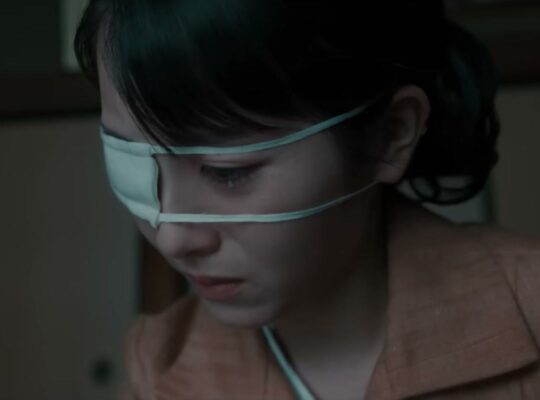
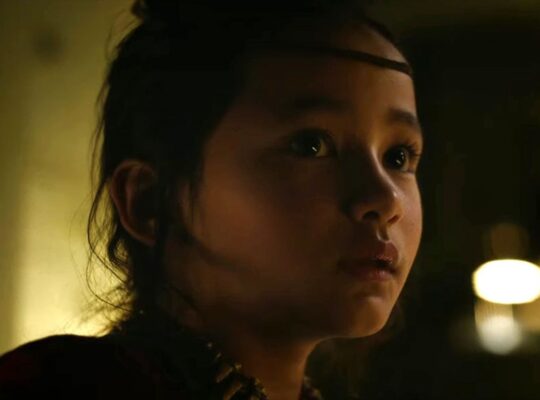
The reel also shows you the family, and this is where it stops being a technical exercise. “Godzilla Minus One” ended with Koichi Shikishima (Ryunosuke Kamiki) finding Noriko (Minami Hamabe) alive in a hospital bed, and with a black mark creeping across her neck that the film pointedly declined to explain. Both are confirmed to return, along with Kenji Noda (Hidetaka Yoshioka), Shiro Mizushima (Yuki Yamada), Seiji Akitsu (Kuranosuke Sasaki) and Sumiko Ota (Sakura Ando), and the story picks up in 1949, two years on. In three separate setups here, a woman in a coral cardigan and a period blouse is wearing a surgical strap wrapped across her face, with the dressing sitting over one eye. Toho does not identify the shot and we are not going to put a name to a face we cannot see clearly, but in one of them a small girl takes her hand and grins up at her, and in another a man in a tan leather flight jacket with aviator goggles slung at his neck is holding her while she bows her head. Whatever happened to that household between 1947 and 1949, it does not look like it went well.
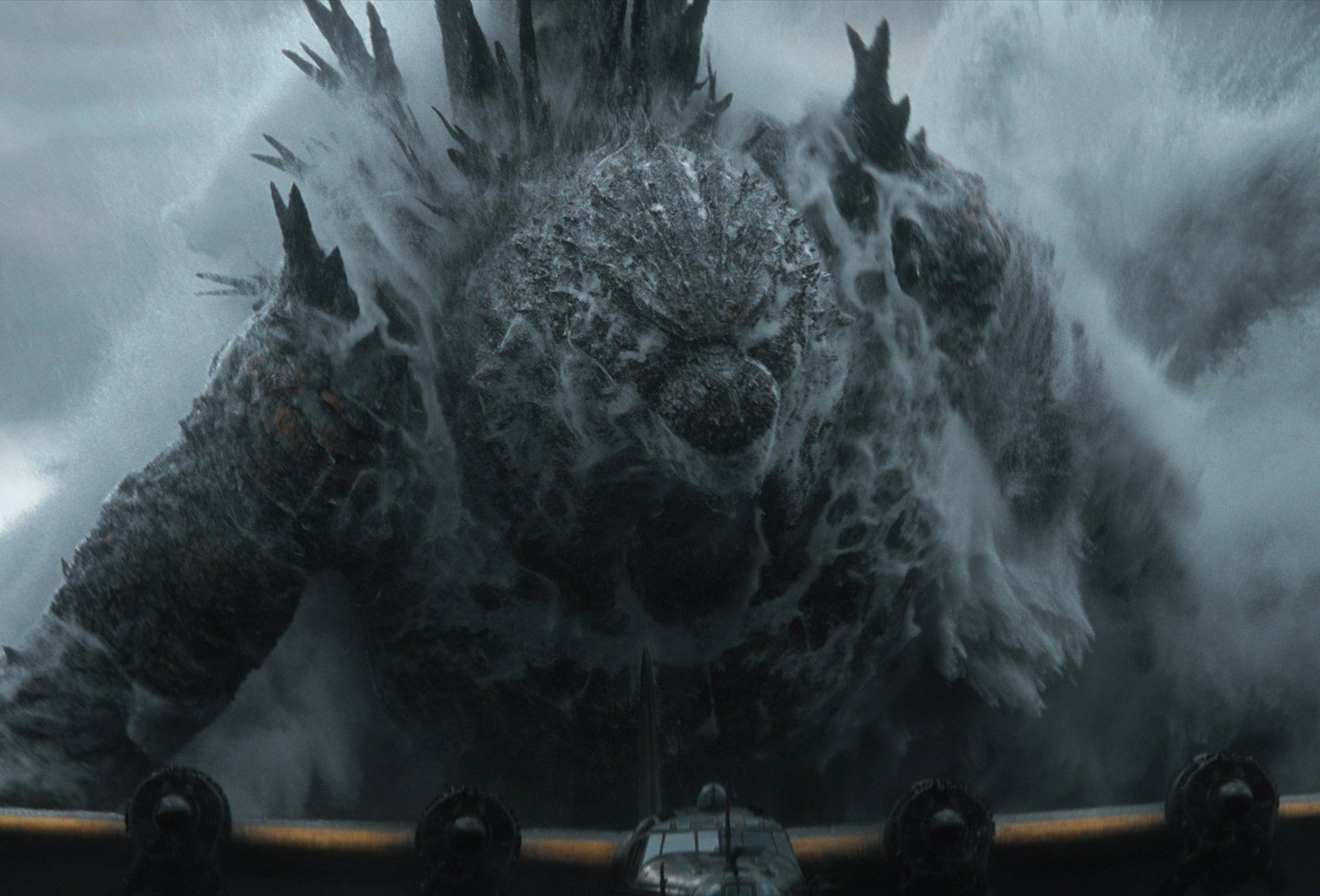
It ends on the work rather than the monster, which is the right call. Yamazaki at the monitors says “Cut!” and then “That’s good!” A little girl in a plaid pinafore cries on cue with a camera rig inches from her face, and seconds later two girls in period clothes are laughing and hugging in a garden. Then comes the only piece of finished film in the whole two minutes: a four engine flying boat charging straight at the lens through its own spray, engines smoking, and a dark mass climbing out of the sea behind it. Toho’s July teaser carries the same shot a beat longer, and that mass resolves into Godzilla’s head and shoulders coming up under the aircraft. THE WORLD IS WAITING, says a card in brushed Japanese lettering. EXPERIENCE GODZILLA ON THE BIGGEST SCREENS, says the next. FILMED FOR IMAX. NOVEMBER 6. ONLY IN THEATRES. The film premieres first at the New York Film Festival on September 26, and opens in Japan on November 3.
What Do You Think? Does a director who supervises his own visual effects have an advantage nobody else in the business currently has, or is Yamazaki simply the only person willing to work that hard for that little? Is the IMAX certification a real jump in ambition for Toho, or a distribution decision dressed up as a creative one? And what do you make of that eye patch, given how carefully “Godzilla Minus One” refused to explain the mark on Noriko’s neck?
Catch up properly: every Godzilla movie in chronological order on our Timeline Hub’s Godzilla timeline.
See you on the next binge!