

Martin told somebody. That is the event of the “Best Medicine” season two premiere, and it is bigger than it sounds, because the thing he has spent a season hiding is the reason he cannot do the job he trained for. Fox aired “Be Careful What You Fish For” on Sunday 20 September, and the show moves to Tuesdays at 8/7c from this week. It opens the season by taking his secret out of his hands, in the one way he can live with.
The confession happens at a lighthouse, and the person he tells is a patient he is talking down. Cecilia has a scaly skin condition she is ashamed of, she has climbed up there intending not to come back, and Martin hands her something of his own instead of a professional reassurance. Warning beyond this point there are spoilers for the “Best Medicine” season two premiere, including how Martin’s blood phobia becomes public and what the town does about it.
The thing he has spent a season hiding is the reason he cannot do the job he trained for.”
What makes the scene work is that it is not a slip. The obvious way to write this beat is an accident, where Martin faints in front of the wrong person and the town finds out without him choosing anything. The show does not do that. He tells her on purpose, because it is the only thing he has that might reach her, and the secret goes public on his terms and in service of a patient. That is the harder version of the scene and the better one.
It is worth being clear about what “Best Medicine” is, because the show has a complicated parentage. It is an American adaptation of “Doc Martin”, the ITV series that ran from 2004 to 2022 across ten series and seventy-nine episodes, with Martin Clunes as Dr Martin Ellingham. It keeps far more than the premise. The town is still called Port Wenn, and the lead is still a brilliant surgeon whose career ended when he developed a sudden phobia of blood.
The relocation is to Maine rather than Cornwall, which is a sensible swap, because both are places where the weather is a character and the locals have opinions about newcomers. What the American version has to solve is tone. “Doc Martin” got away with a genuinely unpleasant lead for eighteen years because British comedy treats rudeness as a form of affection. A network procedural asking an audience to spend twenty-two episodes with a man who is openly contemptuous of his patients is a much harder sell.

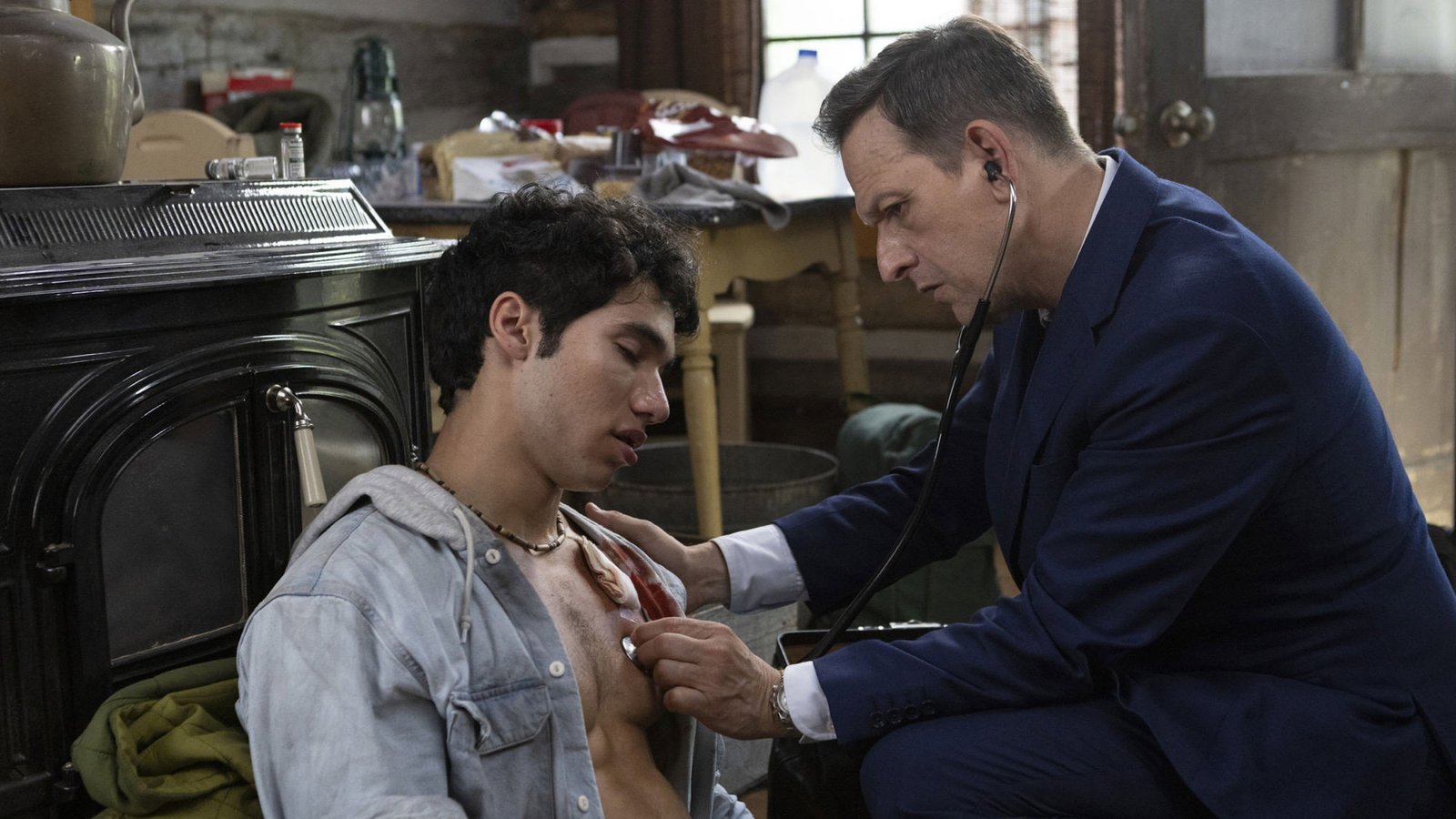
The premiere’s answer is to give him a reason to soften without actually softening him. Martin is still short with people and still incapable of small talk, and the episode does not have him learn a lesson about kindness. What it does is put him somewhere the only useful tool is honesty about his own failure, and then let him reach for it. The character does not change. The circumstance forces him to use a part of himself he keeps locked away, which is a different thing entirely.
It also solves a structural problem the format has always carried. A medical show built on a patient of the week needs the doctor to be the constant, and a doctor whose defining trait is contempt gives you the same scene every episode. Making the phobia public changes what the weekly patient is for, because now every case is a test of whether he can function rather than a test of whether he can be civil. That is a renewable engine. Rudeness is not.
The lighthouse setting is doing work as well. A phobia of blood is an invisible condition, and Cecilia’s is the opposite, written on her skin where everybody can see it. The episode puts the two of them on a ledge and makes the trade explicit. She is ashamed of a thing nobody can miss. He is ashamed of a thing nobody can see. Neither shame is rational and both have cost them a life they wanted, and that is the argument the scene is actually making.

What happens after the confession decides how the season goes. The town does not treat it as gossip, and instead they gather around Cecilia and start volunteering their own struggles, which turns Martin’s admission into permission rather than a scandal. It tells you what this show intends to be. Port Wenn is written as a place that closes ranks around people, and the premiere spends its final act proving it rather than asserting it.
Running against that warmth is a development with teeth. The episode introduces a monitor from the state medical board, assigned to oversee Martin’s practice, and that threat lands very differently now his phobia is not a secret. A doctor who cannot look at blood is a liability on paper, whatever he is worth in every other respect. The show has just handed an official observer the exact fact that could end him, and it did it in the same scene that redeemed him.
That is smart structure, because the confession is a personal victory and a professional catastrophe at the same moment. The season now has an engine that does not depend on Martin being unpleasant to strangers. Whether it sustains that is a different question, since American network seasons are long and the British original solved its pacing problem by making eight episodes at a time and then going away for two years.
Around the two leads the season is stacking its bench. Louisa, the school principal, is pursuing single motherhood, and Andrea Martin has joined as Judith while Eden arrives from Boston as an antagonist. Mark is still the local police officer and Sarah is still Martin’s relative. The premiere spends a reasonable amount of time reminding you who everybody is, which is what a season two opener on a network show is obliged to do.
One detail is worth flagging for anyone coming from the original. The American version has not changed the character’s name. He is still Martin. The town is still Port Wenn. The blood phobia is intact. That is unusually faithful for a network remake. Most of them change everything except the logline, and then wonder why the thing they bought stopped working. Fidelity is not the same as quality, but it is a start.
The adaptation question is the one worth watching. Remaking a beloved British series for American network television has a poor record, and the failures usually come from the same place. The original is built on a specific restraint, the remake adds warmth to make it palatable, and the thing that made it work quietly drains out. “Best Medicine” has spent a season and a premiere resisting exactly that. It has not solved the problem so much as declined to create it.
One last thing, and it is an honest note rather than a criticism. This is the first time we have written about “Best Medicine”, and the reason is that a Fox medical dramedy adapted from a long-running British series is not a show that reaches a binge guide through the front door. It got here by being good on a Sunday night. That is a decent argument for checking things we have no particular reason to check.
What Do You Think? Does Martin confessing on purpose work better than the accidental reveal the show could have written? Can an American network run sustain a lead this abrasive across a full season? And is the medical board monitor a real threat, or a plot device that quietly disappears by episode six?
See you on the next binge!