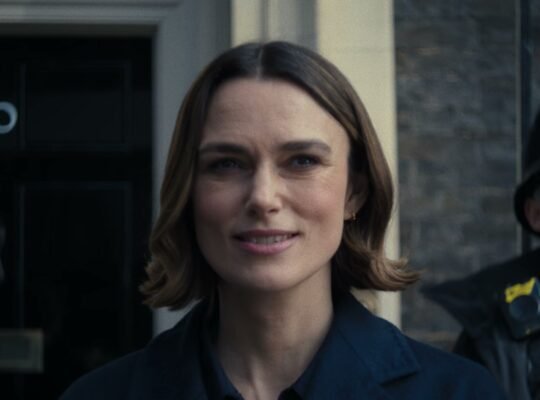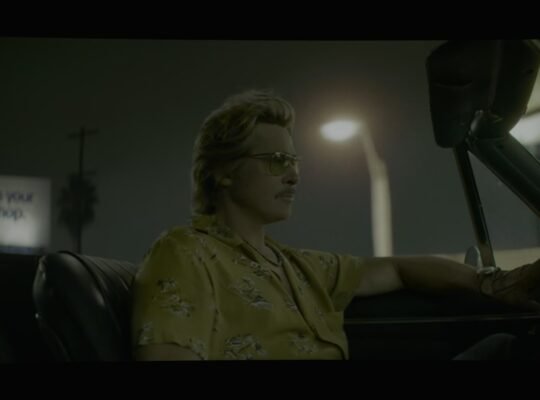
Netflix released the first trailer for Greta Gerwig’s “Narnia: The Magician’s Nephew” on Tuesday, October 13th, and it opens on the most famous piece of furniture in children’s fiction. A hand pulls a green cloth off a carved wooden wardrobe in an attic full of dust sheets. Over that image a voice says, “Sometimes one story is the beginning of all the others.” That is the pitch in one line. Gerwig, who wrote and directed the film, is starting the Chronicles where C.S. Lewis’s own timeline starts. His 1955 novel explains where Narnia and that wardrobe came from. Netflix bills this as the first time the book has reached the screen. The trailer premiered in the IMAX auditorium at AMC Lincoln Square in New York hours before it went online, with Stephen Colbert hosting a Q&A.
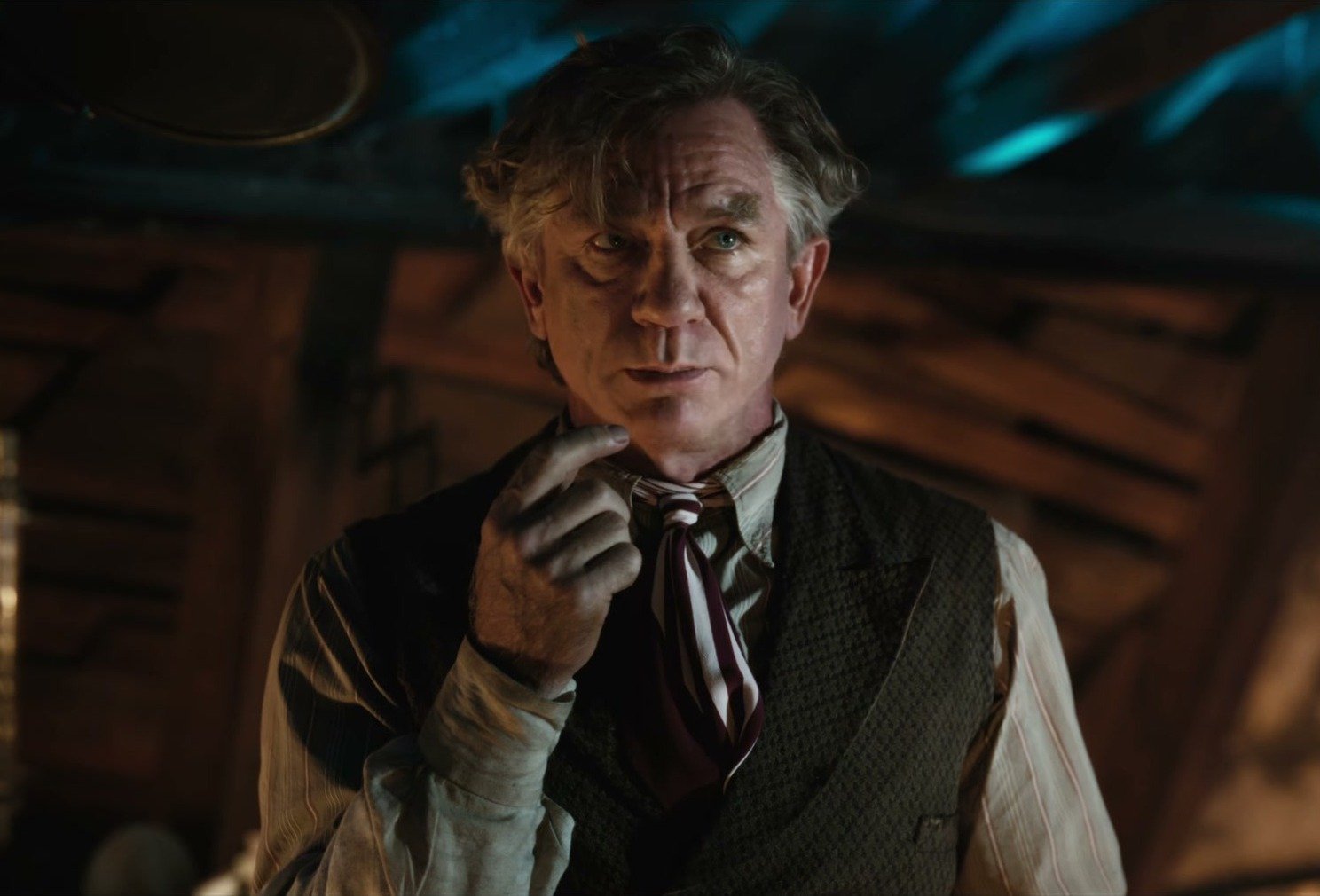
The release plan is news on its own. The film opens in theaters and IMAX on February 12th, 2027, with IMAX-only sneak previews from February 10th. It does not reach Netflix until April 2nd, which leaves seven weeks in theaters. Rolling Stone, The Hollywood Reporter and Vulture all call it the streamer’s first wide theatrical release. Newcomers lead the cast as Digory Kirke (David McKenna) and Polly Plummer (Beatrice Campbell). Digory’s Uncle Andrew Ketterley (Daniel Craig) is the magician of the title. Jadis (Emma Mackey) is the queen who becomes the White Witch. Aslan (Meryl Streep) is a voice role, and Digory’s mother (Carey Mulligan) turns up in the trailer too. Warning beyond this point there are spoilers for “Narnia: The Magician’s Nephew” and for the plot of C.S. Lewis’s novel.
Gerwig, who wrote and directed the film, is starting the Chronicles where C.S. Lewis’s own timeline starts.”
The first stretch stays in our world, and it looks gray and lived-in. After a card reading “Based on the beloved story from C.S. Lewis,” Digory and Polly peer over a rooftop wall. One of them asks, “Is Mr. Ketterley really mad?” Then Craig fills the frame. He holds the round green base of a glass bottle up to his eye like a lens while the line “Mom always calls him a magician” plays over him. A child’s hand strokes the nose of a working horse in harness. “Do you believe in magic?” gets the answer “I don’t know.” The kids climb through a hatch above a washbasin into a dark crawlspace. Polly grins by candlelight as the question comes: “Are you ready?” The answer plays over Digory’s worried face: “How can I be ready if I don’t know what’s on the other side?”
A small door opens on Uncle Andrew’s attic laboratory under a card reading “From Greta Gerwig.” It is a glowing clutter of flasks and brass machines. “Wow, look at all this!” plays over a shot of Polly beaming through the glassware. Hands in red sleeves, the color Polly wears in these scenes, open a box of green and yellow rings and lift out a yellow one. A card bills Gerwig as “the director of Barbie.” Then Andrew stands in the lamplight and says, “I am a magician.” His hand offers Digory something that glows as the line goes on: “But see for yourself.” Digory holds a ring in a wash of light. The next wide shot leaves him standing alone in the middle of the lab.
That is the novel’s machinery, kept intact. In Lewis’s book the yellow rings pull a traveler out of our world and the green ones bring him back. Andrew is too much of a coward to try them himself, so he tests them on children. A card reading “Next Year” gives way to the Wood between the Worlds. It is a green forest of enormous moss-hung trees, seen from above and then from behind the two kids. Hands wearing rings reach for each other. Digory gapes upward, and the lines climb from “There are other worlds?” to “Even infinity worlds!” as the cut moves on to Charn. The pair walk hand in hand into a vast dark hall where debris hangs in the air. In a red and gold chamber of still, seated figures, Digory runs for a table. Someone shouts “Digory! Don’t do it!” and a hand reaches for a small golden bell. Book readers know what that bell does.
It wakes Jadis. A face of molten gold cracks with fiery light while the line “Come to me, my power” plays. Then a pair of eyes opens under glittering eyeshadow, and a card reads “For the First Time.” Deadline’s headline promised a “Punk Rock Multiverse.” Vulture notes that the second half of the trailer is set to Led Zeppelin’s “Stairway to Heaven,” and that sync is a coup. Rolling Stone reports that Robert Plant and Jimmy Page routinely turn the song down for the screen, even for Cameron Crowe. They made an exception for Gerwig. “They saw the heart and the story and the drama in it,” she told Colbert, per Rolling Stone. Digory screams in a red glare, the frame spins into a red vortex and a card promises “Experience the Chronicles.”
What follows is where the trailer departs from the book. A boy scrambles over the rubble of a building gutted to its brick shell. A rider gallops down a city street hung with Union Jacks, past cars that are plainly mid-century models. A little girl gapes from the window of a red bus. Mashable and What’s on Netflix both report that Gerwig moved the story from the novel’s 1900 to the 1950s. After a card reading “From the Very Beginning,” Jadis stands in a sequined minidress in a shower of sparks as the children watch. “Magic, it’s everywhere” plays as the cut lands on Digory’s mother, propped up in bed and mid-sentence. That much fits the novel, where her illness drives Digory’s whole story.
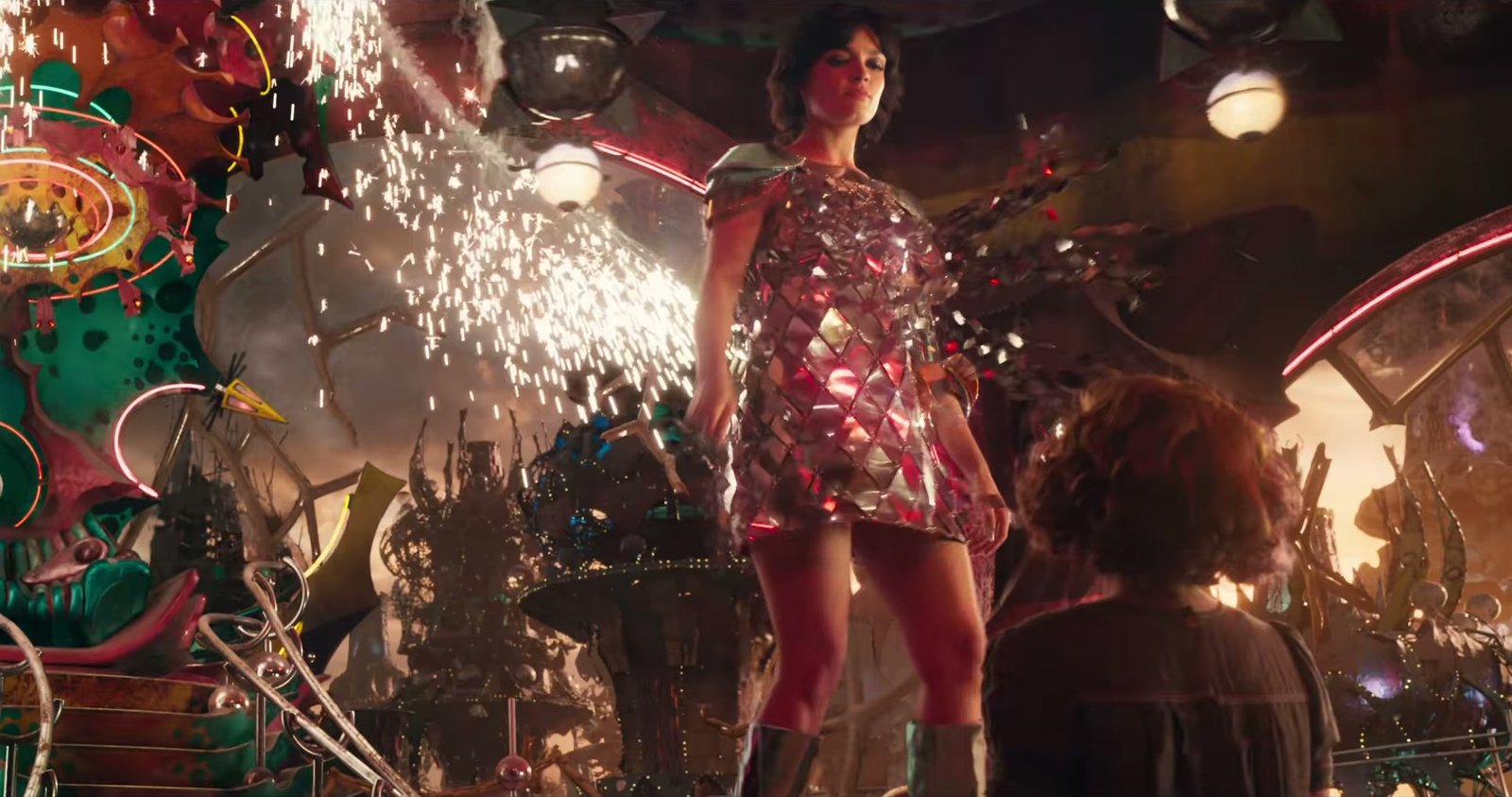
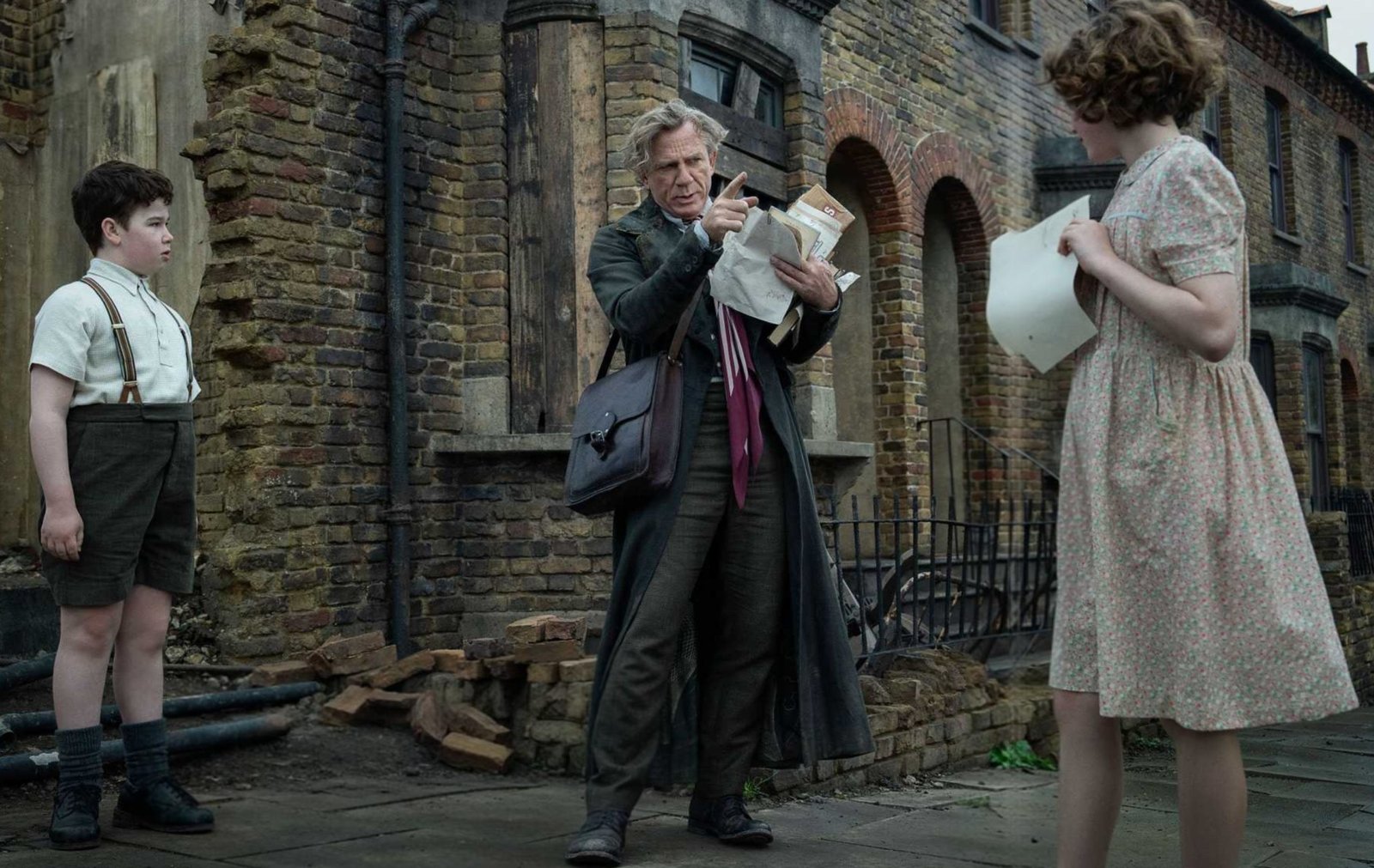
The next shot is the bigger change. Jadis, now in a dress of silver scales, points a wand down a street. A car sits in a cloud of smoke right outside a pub whose sign reads “Eagle & Child.” That name is a wink. The real Eagle and Child in Oxford is where Lewis, J.R.R. Tolkien and their Inklings group used to meet. The wand is not a wink. In the novel Jadis’s spells do not work in our world. She terrorizes London with brute strength and an iron bar torn off a lamp-post instead. A Jadis with working magic in our world rewrites one of Lewis’s own rules, and What’s on Netflix points out that Gerwig did not address it on stage.
Polly and Digory clutch each other in a crowded street, and Digory is in tears. A figure in a glowing ice-blue gown stands in a dark forest as a voice says “In the darkness.” A red sun hangs over a city of black spires, which matches the dying sun Lewis gave Charn. A winged horse leaps off a crag with two riders, and Variety names the film’s flying horse as Fledge. Uncle Andrew crouches in thick grass and stares upward as the voice finishes with “and the light.” Then the screen goes black for a final question: “Have you ever seen a world born?”
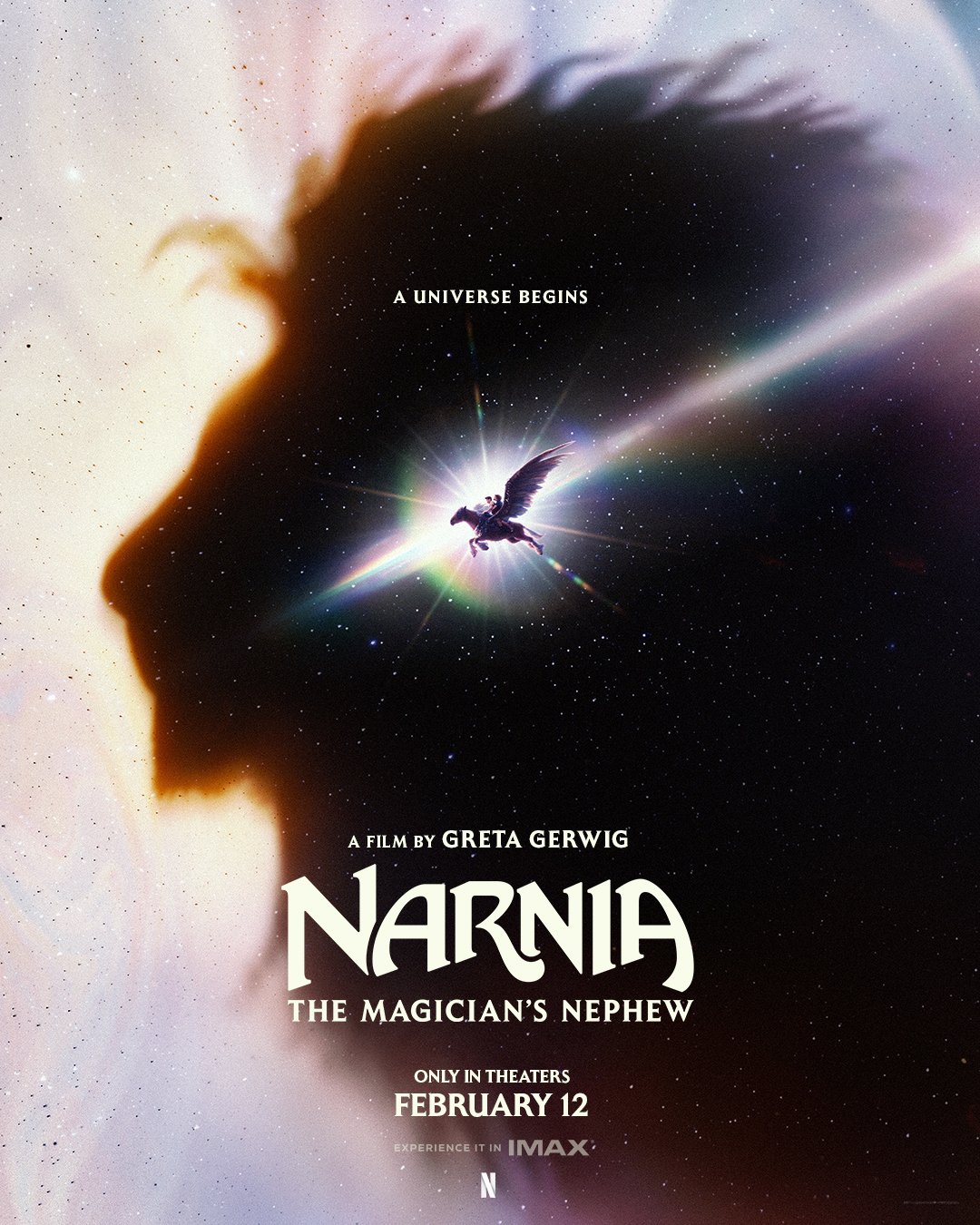
Three silhouettes watch light pour into the dark. Polly and Digory stare upward with a nebula swirling behind them. A lion’s head forms out of drifting star dust. The finished lion, a black silhouette, opens its jaws against an explosion of color. That is Aslan. In the novel Aslan sings Narnia into being, and Gerwig told Netflix that “a universe built out of music is an idea that always lived in my heart.” Casting Streep has already drawn fire from conservatives, as the Guardian and The Hollywood Reporter both note.
The verdict is mostly good. The trailer is faithful where it counts: the attic, the rings, the Wood, the bell, the witch, the flying horse and a lion who builds a world out of nothing. Its gambles are the rock soundtrack, the jump to the 1950s and a Jadis who brings working magic into our world. Reactions split hard. The Hollywood Reporter collected posts ranging from “best trailer I’ve seen in years” to “a bizarre, disastrous fever dream.” The music and the effects are matters of taste. The magic rule is not, because her failed spells in London are one of the novel’s best jokes.
What Do You Think? Does a Jadis who can cast spells in our world break something important in Lewis’s story, or is it a fair trade for a bigger second act? Will the move from 1900 to the 1950s matter once the story leaves our world for Charn and Narnia? And with “Stairway to Heaven” opening the door, how much rock music do you expect Gerwig to put inside the film itself?
See you on the next binge!