
Netflix released all eight episodes of “The Altruists” on Thursday, November 19th, 2026. The limited series follows the rise and fall of the crypto exchange FTX through Sam Bankman-Fried (Anthony Boyle) and Caroline Ellison (Julia Garner). Netflix sells it as “A toxic love story inspired by a real fraud.” The October trailer sold the same angle. The full season keeps that promise, and the promise is the problem.
Critics split on one question: can a love story carry a fraud? The Hollywood Reporter says the romantic angle “doesn’t entirely work”, while TV Guide calls the series a “fascinating true crime drama.” IndieWire praises the leads but finds the romance “too cutesy.” Slate is blunter still and calls the show “terrible TV that’s also incorrect on the merits.” Both camps have evidence. Boyle and Garner are excellent, and the show spends eight hours explaining a financial collapse through a love story. Warning beyond this point there are spoilers for all eight episodes of “The Altruists”, including the finale.
Boyle and Garner are excellent, and the show spends eight hours explaining a financial collapse through a love story.”
The opening episode sets the structure. The series cuts between two timelines named “Rise” and “Fall.” In the early one Sam is a junior trader who practices human interaction in the mirror. Caroline is a new hire who meets him as a kindred spirit. On an entrance test she goes all in every time, the “mathematically optimal” play. Effective altruism, the movement built on doing good with money, supplies the excuse for the risks that follow. The later timeline opens in the Bahamas in 2022. The exes are scrambling to cover the missing $8 billion in customer money. The company buys the crypto lender Voyager Digital to bury the truth.
The next episodes explain how the hole got there. Sam starts FTX with Caroline running Alameda. His founding partner Tara Mac Aulay (Greta Carew Johns) objects to the risk. He hires his friend Gary Wang (Eugene Young) without telling Caroline, and the rift shows. In the later timeline Nishad Singh (Karan Soni) learns the truth and cuts off his new romance with Claire Watanabe (Naomi Okada) to keep her clear of it. A reporter closes in on the company at the same time.


The show also leans on Ellison’s Harry Potter fan fiction. Netflix’s own explainer says it is unclear whether the real Ellison wrote any. The erotic stories show up in the early timeline and go viral in the later one. THR opens its review on that viral moment.
The middle of the season widens the circle. Sam’s father, Joe Bankman (Paul Reiser), joins FTX as things go bad. His mother is Barbara Fried (Robin Weigert). The show gives the parents one sharp line, when another character explains that they love their son but do not like him. One episode plays out over a handful of employee game nights, a structure TV Guide singles out. Show Snob’s recap of that stretch has Sam moving to push Caroline out of the company while Caroline and Nishad plan to push him aside. The partners are now rivals.
Sam Trabucco (Alex Lawther) leaves the companies for the open seas. THR quotes him on what the pair do to each other: “Sam was a block of sodium. Caroline was a rushing river.” CZ (Terry Chen) later announces that his company is selling its FTT, the coin FTX created. The price crashes as customers rush to pull out their money.
Creator Graham Moore says the story nearly stops at a happy moment. A few minutes before the end of episode seven, Sam and Caroline share a scene on a beach. Moore jokes that if it had “just faded to black right then” it would be “the happiest story ever committed to film.” He adds, “There is, however, about 60 more minutes.” By then FTX is in free fall, and Caroline is left as the fall guy for the company’s misuse of customer money.


The finale turns into a race for witnesses. Caroline, Nishad and Gary each cooperate with prosecutors, and Caroline signs a cooperation agreement. Sam goes on a short press tour to argue that the money is not gone but parked in FTX’s investment in the AI company Anthropic, and Netflix calls the tour “ill-fated.” Ryan Salame (Matt Rife) jumps ship.
The finale ends on a phone call. Caroline rings Sam and tells him she loves him. Sam is arrested before he can answer. Netflix says the call is a fictional scene written for the series. Title cards close the show with real outcomes: Bankman-Fried was sentenced to 25 years in prison and Ellison to two years, and Ellison was released after a little more than a year.

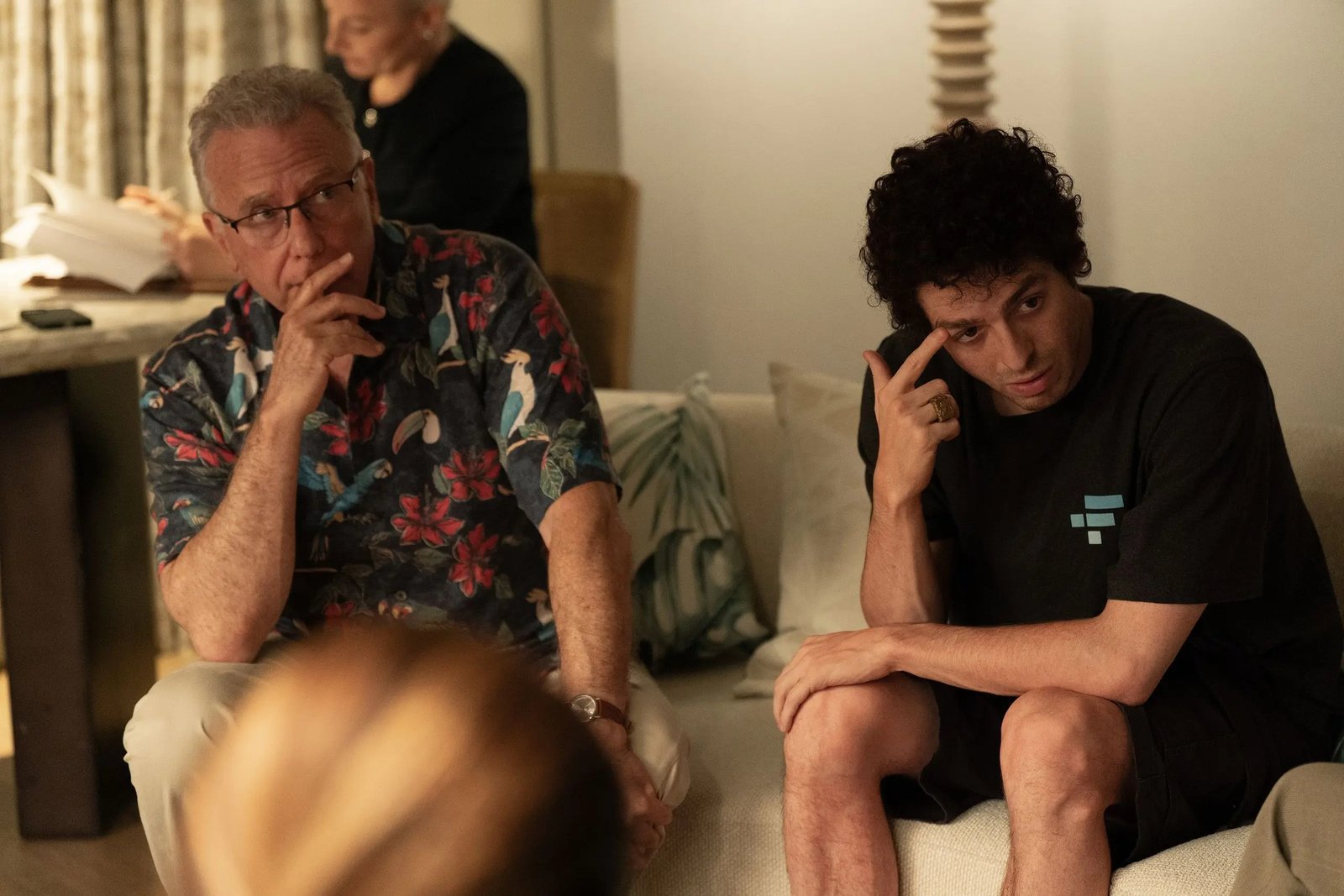
The real story fares worse than the romance. Moore says a newspaper might not be able to show the intimate moments, so the show creates “the ones that happened off camera”, and the series draws on New York magazine reporting by Kevin T. Dugan and Jen Wieczner. THR and Slate both fault the show for leaving out the customers who lost their money. Slate and TheWrap both read it as tilting blame toward Ellison: Slate says the show “tries to inculpate almost everyone except the man at the center of the scheme”, and TheWrap says the series portrays her as “the most actively conniving of the pair.”

The two leads carry the load. Netflix’s cast guide says Garner wore prosthetic teeth and a false nose to play Ellison. It says Boyle visited a comic book store and Magic: The Gathering seminars to pick up Bankman-Fried’s mannerisms. Moore says he had “a thousand different interviews” to study. The two met in a room for the first time at rehearsals in Vancouver a few weeks before shooting. Moore says he was in tears within about 30 seconds. THR says Boyle “disappears into the part of Sam”, and TV Guide calls Garner’s Ellison “no less magnetic”. TheWrap dissents and calls Garner’s performance “so overtly mannered”, while finding Boyle “more grounded.”
Behind the camera, Moore is the Academy Award winner behind “The Imitation Game”. He runs the show with Jacqueline Hoyt, and James Ponsoldt directed the opening episode. THR says Ponsoldt shot the early timeline in “the warm bright tones and slightly grainy texture of an indie rom-com” and calls the later one “grayer.” The contrast earns its place, and it does the work the script keeps explaining out loud.
The supporting cast gets less room. IndieWire says the two-timeline structure leaves everyone else as “one-note (or sometimes no-note) archetypes”, though THR praises Alex Lawther and Karan Soni and TV Guide adds Eugene Young for the dark comedy he brings to Gary. The length divides critics too. IndieWire says the romance “isn’t sustainable enough entertainment to support an eight-hour story”, while TV Guide says it is “a big story that needs the space” the series gives it.
The verdict splits in two. As a study of two people who cannot say what they mean, the show works. As an account of how $8 billion went missing, it does not. A love story can explain a couple but it cannot carry a fraud this size, and THR calls the lesson the show settles on “an unreasonably expensive one.” Collider’s headline says the show “Tricks You Into Thinking It’s Good”, and the trick holds for as long as Boyle and Garner share a scene. Netflix lists it as a limited series, and the finale closes the story.
What Do You Think? Can a love story explain a fraud, or does it let the fraudsters off easy? Did Caroline’s final call land as heartbreak or as invention? And would the season have worked better with the customers on screen?
See you on the next binge!