
The first thing A24 shows you is a plate of chocolate chip cookies. No dialogue, no music cue, just a slow push on the most recognizable prop in mid-2000s television, sitting on a kitchen counter in a house that only exists to be a trap. Anybody who was near a TV in 2006 knows exactly what that plate means and exactly who is about to walk through the door. That is the whole trick of the “Primetime” trailer, which A24 dropped this week ahead of the film’s world premiere at Venice, and it works because the movie understands that the show it is about was never really about crime. It was about staging.
Here is what we are looking at. “Primetime” is Lance Oppenheim’s first narrative feature, written by Ajon Singh, with Robert Pattinson playing Chris Hansen in 2006, the year “To Catch a Predator” went from a Dateline NBC segment to an event. It runs 107 minutes, it plays in the main competition at the 83rd Venice International Film Festival, which runs September 2 through 12, and A24 puts it in theaters on September 25. Merritt Wever plays Hansen’s producer, Skyler Gisondo plays a young actor hired into the sting operation, and the supporting cast runs through Anna Faris, Bokeem Woodbine, Matthew Maher, Tony Revolori, Creed Bratton and Phoebe Bridgers. Ari Aster is one of the producers, alongside Pattinson himself. Warning beyond this point there are spoilers for the full “Primetime” trailer and for the real 2006 events the film is built on.
Anybody who was near a TV in 2006 knows exactly what that plate means and exactly who is about to walk through the door.”
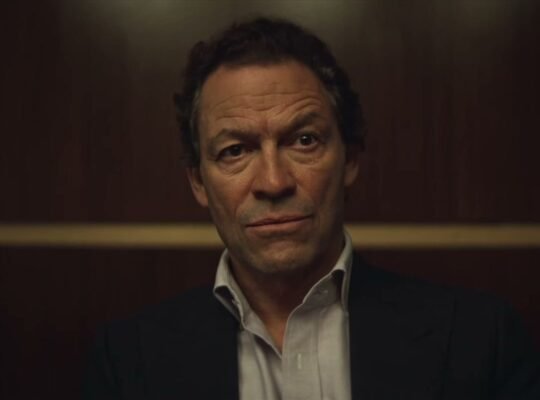
The trailer opens inside the operation rather than outside it. Two hidden camera feeds sit side by side on a monitor, timestamped and marked REC, watching an empty suburban living room, and even the A24 logo comes up doubled across both panels. A voice says “come on in.” A man in a white t-shirt steps through a doorway into green light. The cookies. A woman’s voice, chirpy and rehearsed, asks whether his parents are home, and he tells her he is sure they are not, and then asks who she is. Somebody says “won’t you have a seat right there,” and the cut lands on Pattinson in close-up for the first time, jaw set, tie knotted, delivering the line that defined a decade of television: “I’m Chris Hansen with Dateline NBC, and we’re doing a story on adults who try to meet teens online.” Then, quieter, almost kind: “You see how this looks, right?” It is an uncanny piece of mimicry, and the trailer knows to let it sit.
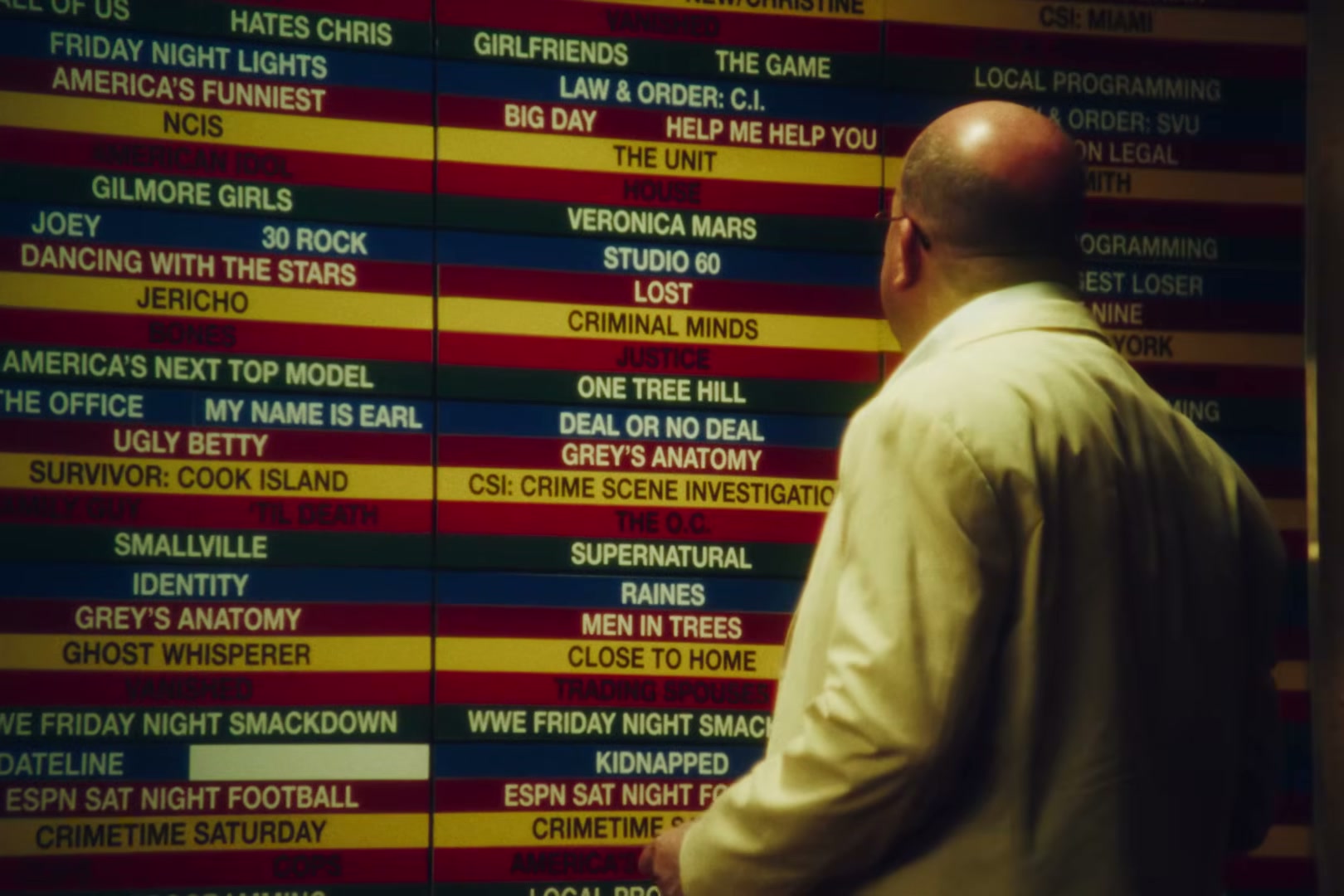
From there it jumps to the part of the story nobody dramatized at the time, which is the network. A bald executive stands in front of a wall-sized scheduling grid, and you can read the 2006 NBC lineup on it if you pause: Friday Night Lights, Gilmore Girls, 30 Rock, The Office, Studio 60, Deal or No Deal, Dateline. He tells Hansen “I don’t really like your show,” and then, without changing tone, “but America loves it.” The segment gets moved to nine o’clock. Somebody says it will be bigger than Lost. The Hollywood Reporter identified that executive as Jeff Zucker, the real NBC chief of the era, playing himself, which is a genuinely strange casting choice and also the clearest signal of what this film is doing. The man who greenlit it is in it.
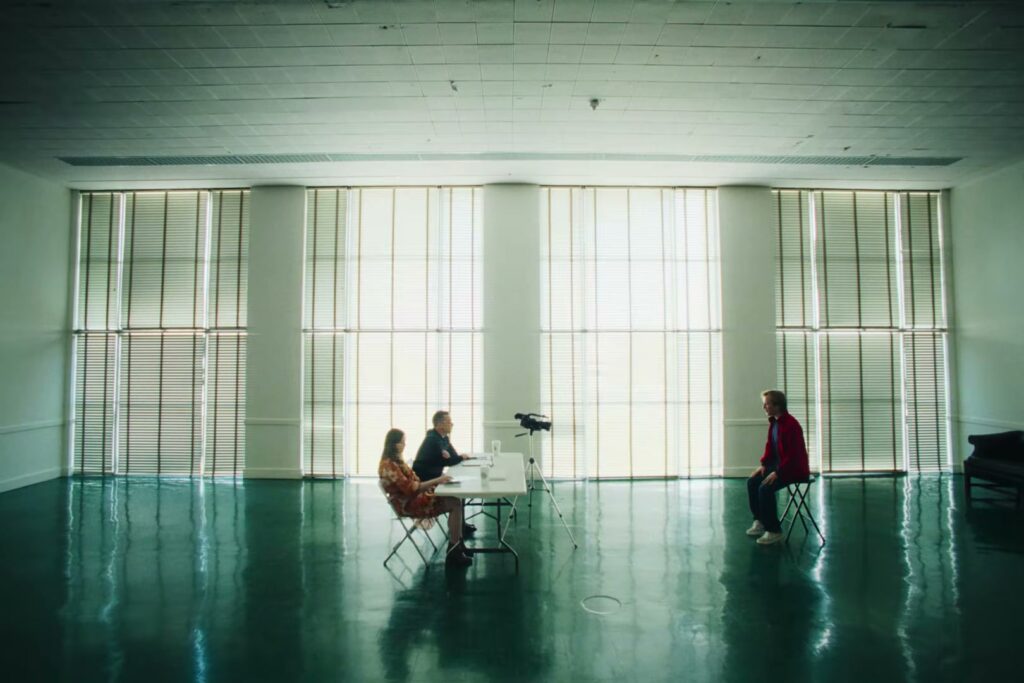
Then comes the sequence that reframes everything. A vast white room, two chairs at opposite ends, a camera on a tripod between them. A young man says “my name is Dan Plumb.” Somebody asks whether he knows what he is auditioning for. Somebody else asks, flatly, whether he was going to prank a 13-year-old. Plumb asks if there is time for a rehearsal, and the answer is the most damning line in the whole minute: “we’re going to shoot the rehearsal.” The word “come in” is delivered as a cue, not an invitation. “They’re going to love this.” The show is not catching anybody. The show is casting.
The middle stretch is where the trailer stops being clever and starts being ugly on purpose. Hansen, in voiceover over shots of a bedroom monitor and a plate and a hallway, says “Predator has never earned the recognition it deserves,” and then, “I want something that matters. No more bottom feeders. I want a whale.” Someone asks him whether he ever just wants to bleed them. And Pattinson, in one of those flat readings he has been perfecting since “Good Time,” answers that maybe what he does is a little worse. Cookies, cameras, a scheduling grid, a man saying he wants a bigger fish. The trailer is laying its thesis out in the open and daring you to disagree with it.
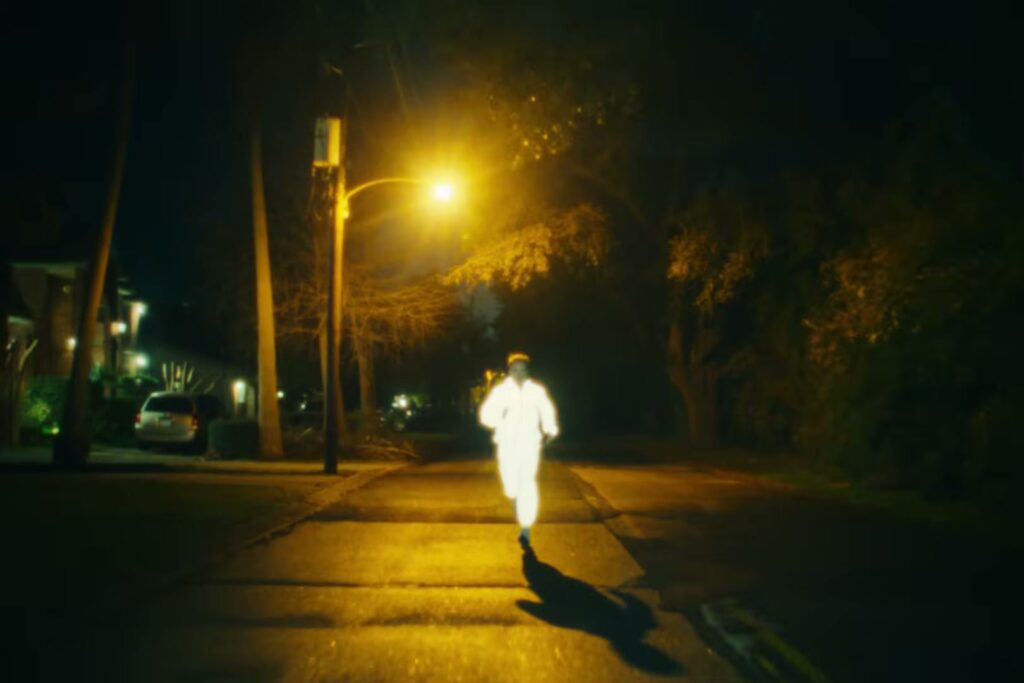
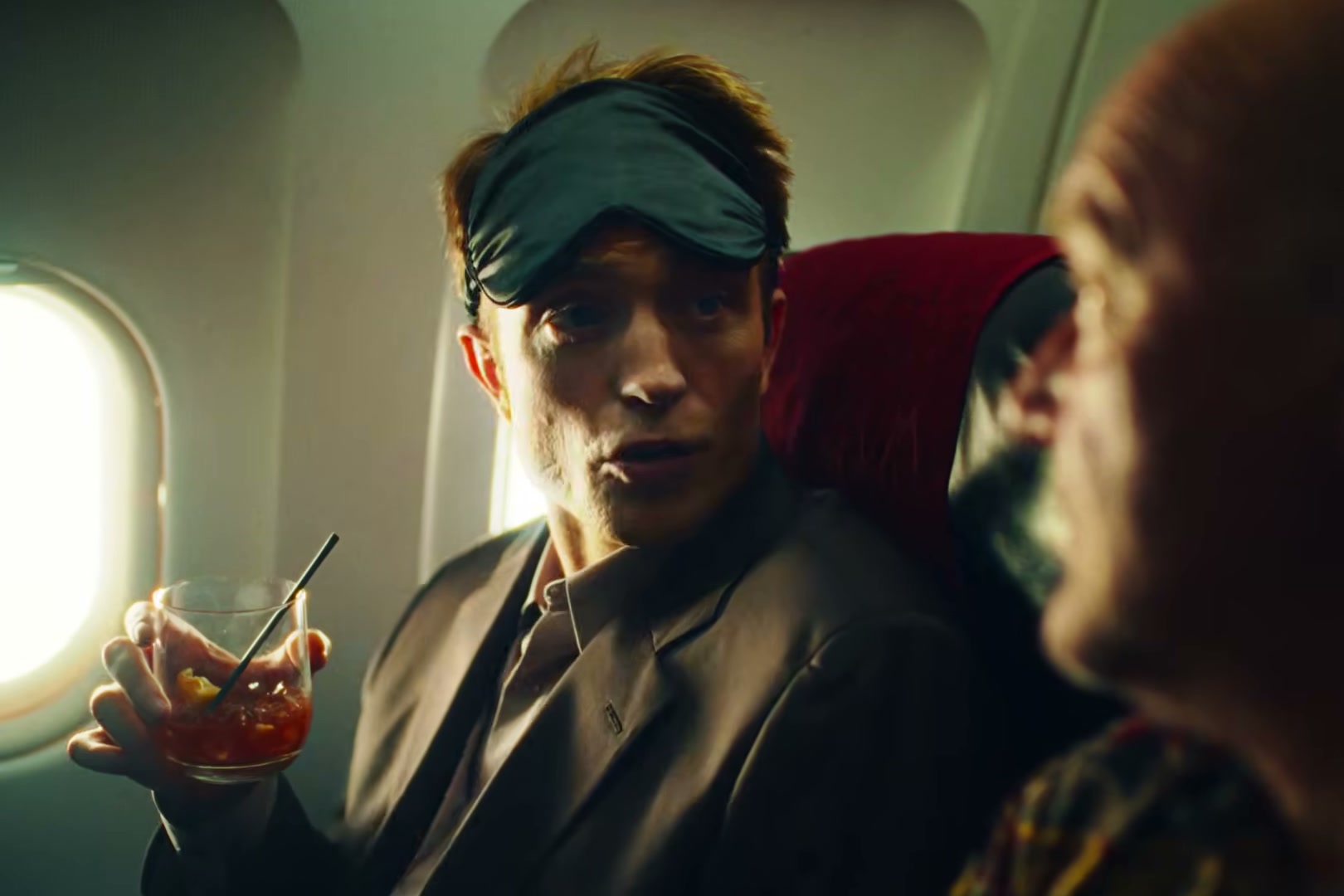
The last forty seconds accelerate into a montage of the operation coming apart. “This could be our greatest segment yet.” An argument about method that tells you everything about what changed: “we’re going to him,” somebody says, and the answer is “don’t do that, they come to us.” Plumb, out of his depth, says he does not understand what he is doing here, and a voice tells him that what he is doing is more than acting, that he is cleansing the world of an ancient evil. Somebody says “let’s catch us a predator” like a slogan. Then the pushback arrives in fragments, one line per cut, over shots of police lights and a hotel room and a face going out of focus in the dark: who gave you permission to do this, you have no plan, I have to put him on television. Pattinson on a plane with a sleep mask pushed up on his forehead and a drink in his hand. A blue title card, PRIMETIME, in CRT type. And under it, the last line, played straight and left hanging: “What would have happened if I wasn’t here?”
If that ending feels loaded, it is, and here is the part the trailer never says out loud. In November 2006, Dateline and the Murphy, Texas police set up a sting house and worked it for four days. One target, Louis Conradt Jr., was a sitting assistant district attorney who never came to the house at all, so the crew and the police went to him. He shot himself as officers entered, with a Dateline camera crew outside. His sister sued NBC for $105 million, the case was resolved in 2008, and the franchise did not survive it. “I want a whale” is not a line a screenwriter invented for flavor. It is the shape of what actually happened, and once you know the ending, that closing question stops sounding like a defense and starts sounding like a man trying to convince himself.

Oppenheim is an interesting choice to hold this material, and the reason is that he has never made a fiction film before. He came up in documentary with “Some Kind of Heaven,” about a Florida retirement community, and then HBO’s “Ren Faire,” which turned a renaissance festival succession drama into something closer to Shakespeare. Both are about people performing a version of themselves for a camera and slowly losing track of which version is real, which is the exact wound this story is built around. Shooting happened in New Orleans in early 2025 under the working title “Bluefin Tuna,” another whale joke, and the film reportedly reunites Pattinson with the producing team behind his strangest recent work. On the evidence of these two minutes, nobody involved is interested in making Chris Hansen a villain or a hero. They are interested in the machine that needed him to keep doing it.
Our reservation is the obvious one, and we would rather say it than pretend it away. This is a film about real crimes against real children, made about a show that has been meme fodder for fifteen years, and there is a version of it that is just a stylish nostalgia object with a great Pattinson impression at the center. The trailer works hard to signal it is not that. The audition room, the rehearsal line, the executive who does not like the show but loves the numbers, the whale, all of it points at television rather than at the men in the house. Venice will tell us within weeks whether the finished film holds that line or whether it flinches. Either way, Pattinson has already done the hardest part, which is making you forget you are watching an actor about four seconds after he says the name.
What Do You Think? Is a film about “To Catch a Predator” only defensible if it stays pointed at the network rather than the stings themselves, or does dramatizing any of it hand the show a second life it never earned? Does Jeff Zucker appearing as himself read as remarkable honesty from a man who ran the network, or as the smartest possible way to control how he gets remembered? And after “Good Time” and “The Batman” and “Mickey 17,” is a real person Pattinson has to disappear into the trickiest role he has taken, or the most obvious awards play of his career?
See you on the next binge!