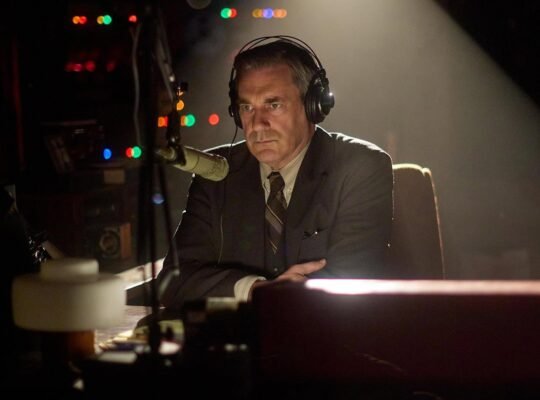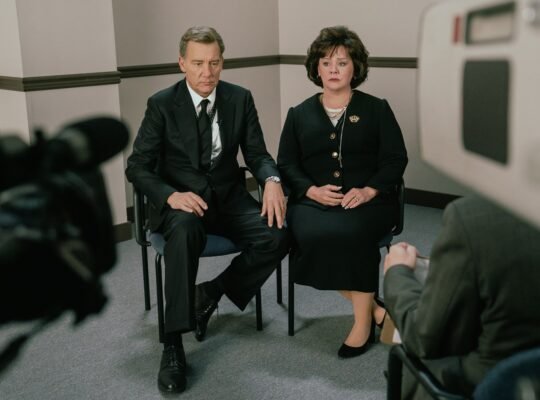
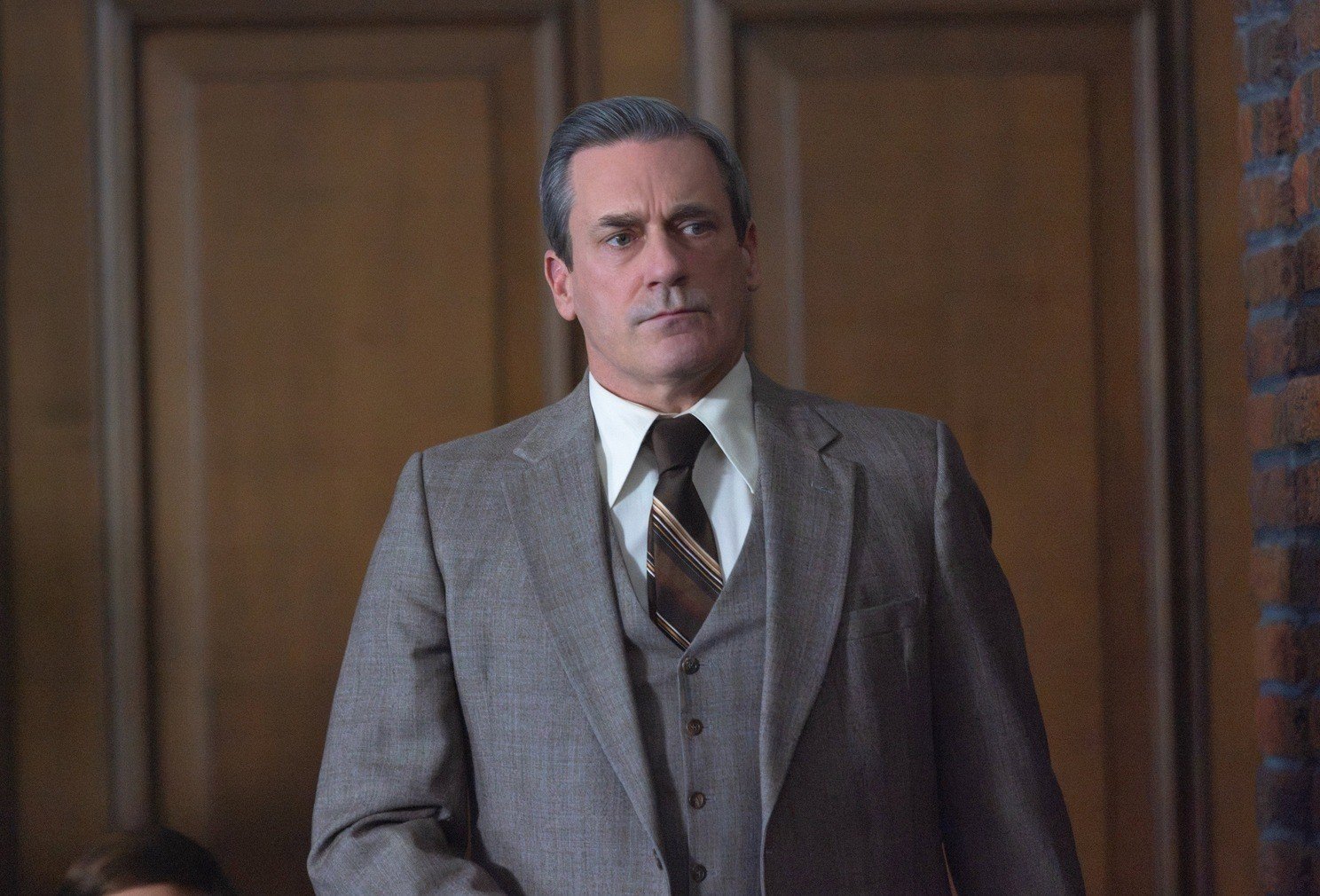
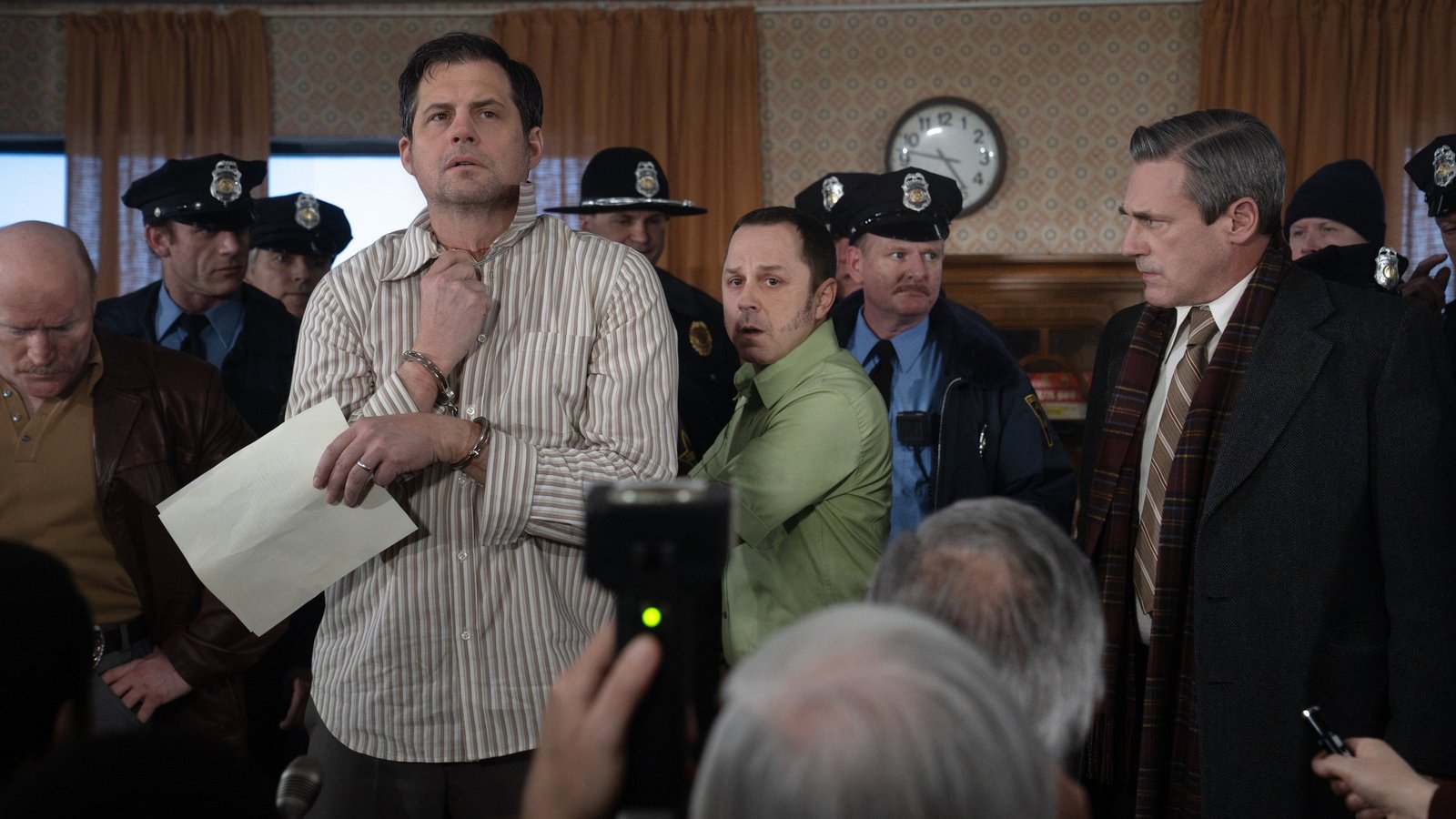
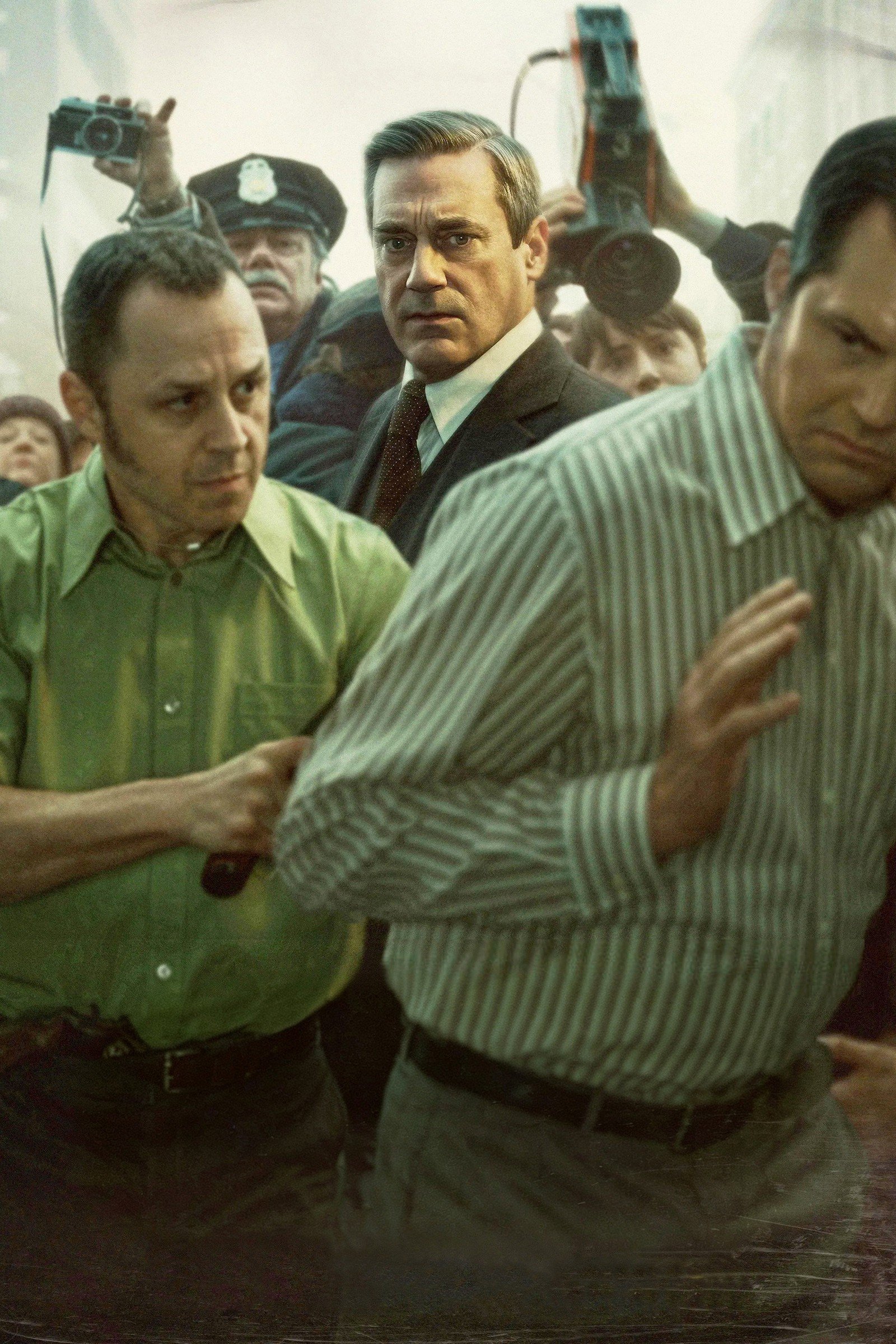
For three days Tony Kiritsis (Giovanni Ribisi) has known Fred Heckman (Jon Hamm) only as a voice on the telephone and the radio. When the two men finally meet face to face, Tony pumps his hand with a shotgun still wired to the neck of his hostage, Dick Hall (Kristoffer Polaha), and says, “Great to meet you in the flesh. Hell of a show.” It is the friendliest moment of the finale and also the most dangerous, because the officers gathered around Tony look ready to shoot at any moment. Everything that follows in “Break the Bank” grows out of that handshake, out of the lie that made it possible, and out of what that lie costs Fred.
That handshake comes early in the season finale of “American Hostage”, which MGM+ released on Sunday, November 1st, to close out an eight-episode run created by Shawn Ryan and Eileen Myers from the podcast of the same name. The series dramatizes the true story of the February 1977 standoff in Indianapolis, when Tony wired a shotgun to the neck of a mortgage company executive and would speak to no one but a radio newsman. Warning beyond this point there are spoilers for the “American Hostage” finale and for the real events of the 1977 Kiritsis case.
It is the friendliest moment of the finale and also the most dangerous, because the officers gathered around Tony look ready to shoot at any moment.”
The hour opens inside Fred’s head, where FBI Special Agent Cormac McNally (Jonathan Tucker) is cleaning up blood and warning him that he “missed it,” and the morning that follows does little to settle him. Fred knows the immunity agreement Tony signed is worthless. He also knows that police and federal agents are staging a press conference at Crestwood, a trap for the man he has spent three days trying to save. The previous hour ended with Fred urging Tony to come downstairs unarmed, according to Comic Basics. The finale’s first question is whether that plea worked, and the answer is only partly. Tony does come down, but he brings the shotgun, and he brings Dick.
At the microphones, Tony makes Dick read a statement laying out his grievances against Meridian Mortgage, then takes the paper and finishes it himself when Dick is too frightened to read. He thanks Fred for giving him a voice, insisting that without the newsman’s unbiased reporting he would be written off as a thug. He also demands that his lawyers secure the front ten acres for $137,000 while Meridian keeps the back seven. His attorney, John Ruckelshaus (Adam Arkin), leaves the building, and Tony stops to apologize to his brother Jimmie (Fred Ewanuick), who is hiding in a bathroom and crying over the damage to his political hopes. Fred imagines Chief Gallagher (Mark McKinney) shooting Tony, and the gunshot is only in his head.
The standoff ends the way the lie always threatened it would. Fred suggests they leave the cameras and move to a back room so Tony can settle, the shotgun goes off through the window, and officers rush in and take him down. “I have immunity!” Tony shouts, and Gallagher replies, “You voided the deal when you came down armed, Tony,” a condition TV Insider notes was never written into the agreement. “You were never going to give it to me anyway,” Tony says, and then he turns to Fred and asks whether he knew. Dick is alive and the wire is off, and Fred is left, in TV Insider’s words, wondering “whether he saved a life or helped destroy one.”
Two months later the story moves into a courtroom, where Tony faces charges of kidnapping, armed extortion and armed robbery and tries to defend himself with the immunity deal. Fred learns that Gallagher told Meridian the promissory note was fraudulent in their very first phone conversation, and the recordings of Tony’s negotiations vanish in a fire the show makes sure viewers see. Tony fires his attorney and questions Gallagher and his former lawyer himself. When Fred finally takes the stand, ready to say “Tony, I’m here to tell the truth,” Tony will not give him the opening. Tony is found not guilty by reason of insanity, and TV Insider notes that Ruckelshaus is seen celebrating with the authorities whose actions had come under suspicion.
The scene that lingers belongs to Dick. Meeting Fred at a bar, he admits he is bitter about how much attention Fred gave Tony during the crisis, and when Fred asks how he survived, Dick says he retreated to a quiet place inside himself where nobody could reach him. Comic Basics suggests the most pointed moment of the hour may belong to Dick, and it is hard to argue. The scene reminds viewers that the man with the wire around his neck was a person and more than a plot device. Fred answers with a confession of his own: in their final moments together in the back room he secretly recorded Tony and Dick, and he has never shared the tape.
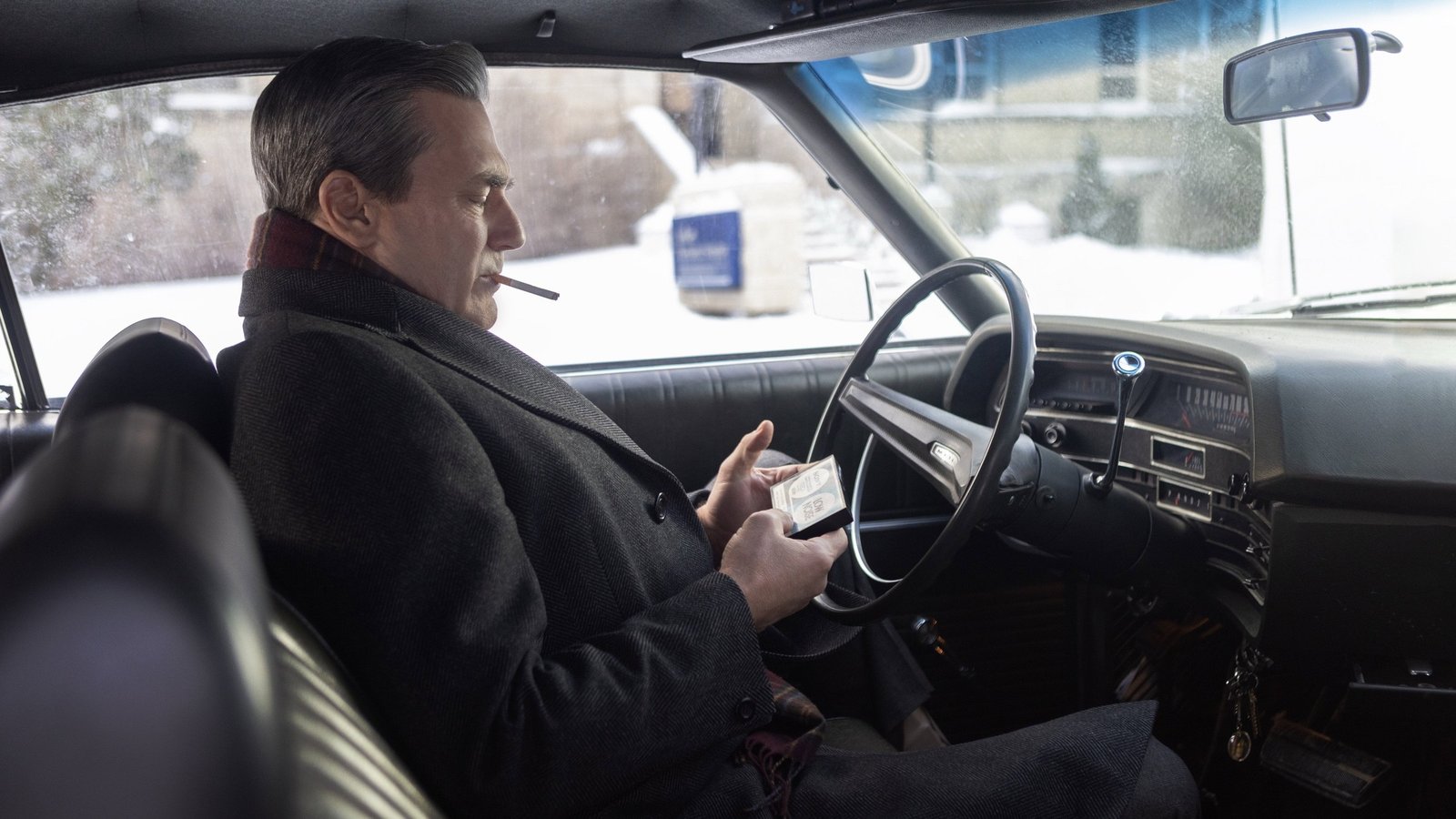
Fred’s last act is a visit to the psychiatric institution where Tony has been sent, carrying a file of evidence about the collusion around the case. In Fred’s imagination it goes beautifully, with Tony smiling and saying, “We certainly gave them a good show, didn’t we, Fred?” until Fred catches himself with “You would never say that,” and the fantasy collapses. In reality Tony refuses to see him, Fred leaves the evidence behind while Tony watches him go from a window, and back in his car Fred destroys the recording. Tony retreats into a daydream of his own, a bustling steakhouse where friends and enemies gather and Fred’s family arrives as welcome guests.
The finale then closes by telling viewers what became of the real people. According to the finale, Meridian bought Tony’s land for $180,000 at a sheriff’s sale in December 1978, exactly as he had predicted. Dick eventually divorced and stayed sober, and the investigation into police corruption was shut down within weeks. Tony spent ten years in contempt of court, by the show’s count, though Indianapolis Monthly puts his time in institutions and prisons at 11 years, and he was released in 1988. The real standoff ran from February 8th to 10th, 1977, and Time and Indianapolis Monthly put it at 63 hours, while TV Insider’s recap counts 68. The last image is footage of the real Tony Kiritsis.
Ribisi is at his best when Tony is happiest, because the press conference lets him play a man who has been handed the audience he wanted, and the show lets him be ridiculous before it lets him be sad. Hamm seems to spend most of the hour reacting, which suits a character who has talked his way into the story and cannot talk his way out of it. Polaha makes the most of the scene that belongs to Dick. Nina Lopez-Corrado, who took over from Adam Arkin for the back half of the season, directs a teleplay by Eileen Myers and Sharon Hoffman, from a story by Stacy McDonald. The finale leans on fantasy more than once, which is perhaps its riskiest choice.
Where critics split, and have since the season began, is on whether the show earned its length. The Hollywood Reporter wrote that the series “peaks in the middle and overstays its welcome,” while Geek Vibes Nation, after binging the season, found that it “finds its rhythm in those final two episodes.” TV Guide, which watched all eight episodes, called the show overstuffed but ambitious. It said the fantasy sequences in the later episodes often feel like padding, which is the device the finale leans on. The Koalition, reviewing the finale itself, says the hour “left us asking more questions about what was real” and what was added as what-if scenarios.
As a season, “American Hostage” is a handsome and stubbornly watchable drama that never quite decided how funny it wanted to be or how much of its time belonged to Fred rather than Tony and Dick. It might have been tighter at six episodes. The finale is stronger than much of the middle because it lets consequences land: a hostage who is bitter, a newsman who keeps a tape and then destroys it, and a gunman who was lied to at every turn and still ends up alone with his daydream. Comic Basics reports that MGM+ has not announced a second season, and quotes Shawn Ryan saying “this has always been pitched as an ongoing anthology series,” so a return would mean a new crisis.
What Do You Think? Was Fred right to lie to Tony about the immunity deal if it saved two lives, or did he owe Tony the truth no matter the cost? Did the finale’s fantasies, from the imagined gunshot to the steakhouse, deepen the ending or blur what really happened? And should “American Hostage” return for a second season with a different crisis, or is Fred’s story the one worth leaving alone?
See you on the next binge!