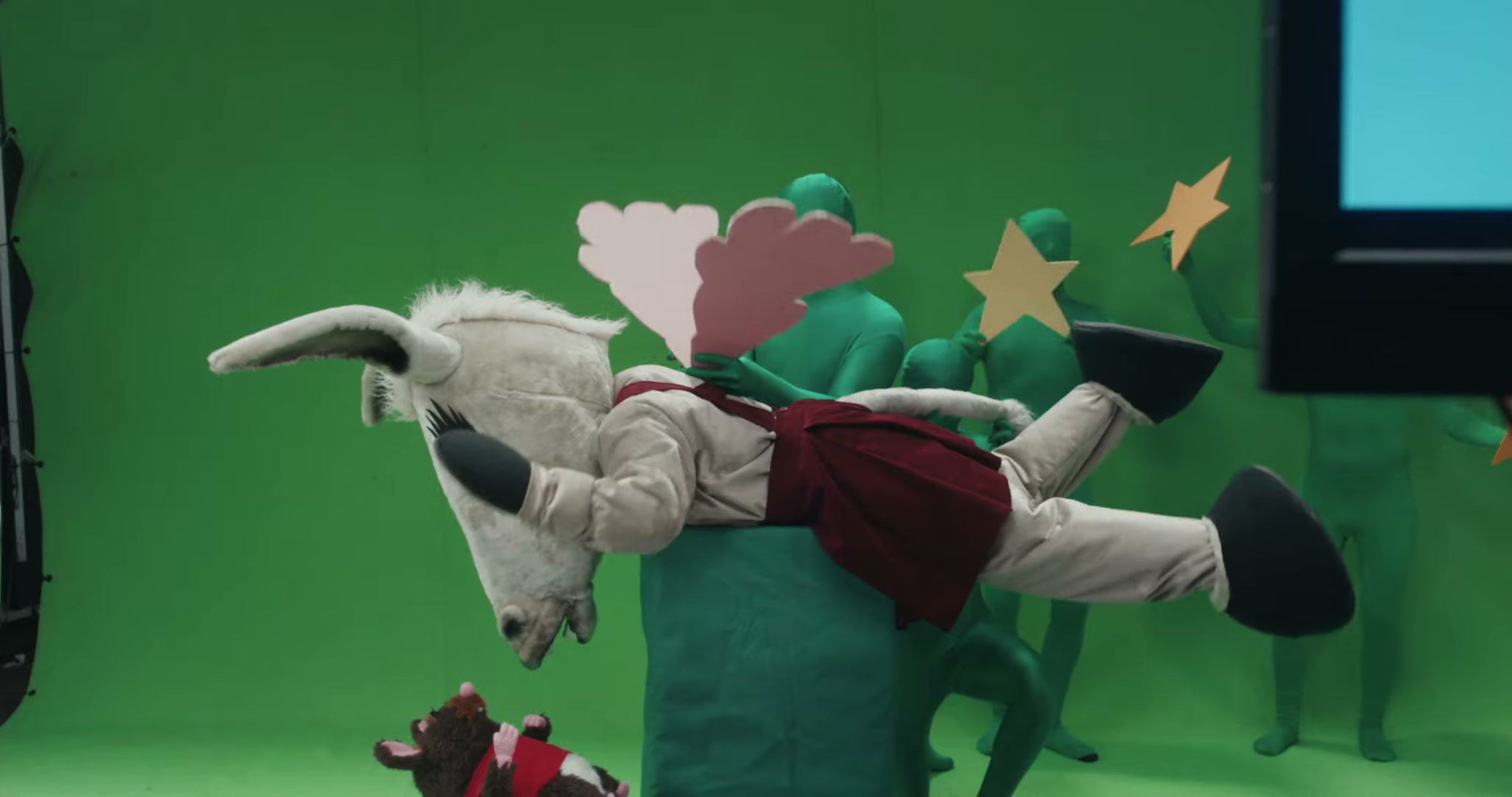
A little over a minute into the first trailer for “Donkey Princess,” a life-size donkey takes flight across a soundstage. Cardboard clouds bob on sticks behind it. A paper star wobbles into frame from the right. And holding the animal aloft, in full view of the camera, are performers in head-to-toe green morph suits, working against a green screen nobody ever got around to keying out. Most trailers burn their run time convincing you the magic is real. This one spends it showing you the wires.
That instinct is the signature of Cristóbal León and Joaquín Cociña, the Chilean duo who built “The Wolf House” out of paint, papier-mâché and stop-motion nightmare logic, then followed it with “The Hyperboreans.” They are the kind of filmmakers other filmmakers seek out, Ari Aster among them. Their third feature world premieres in international competition at the 79th Locarno Film Festival on Friday, August 7, and The Hollywood Reporter has the exclusive on the trailer that finally shows what it looks like.
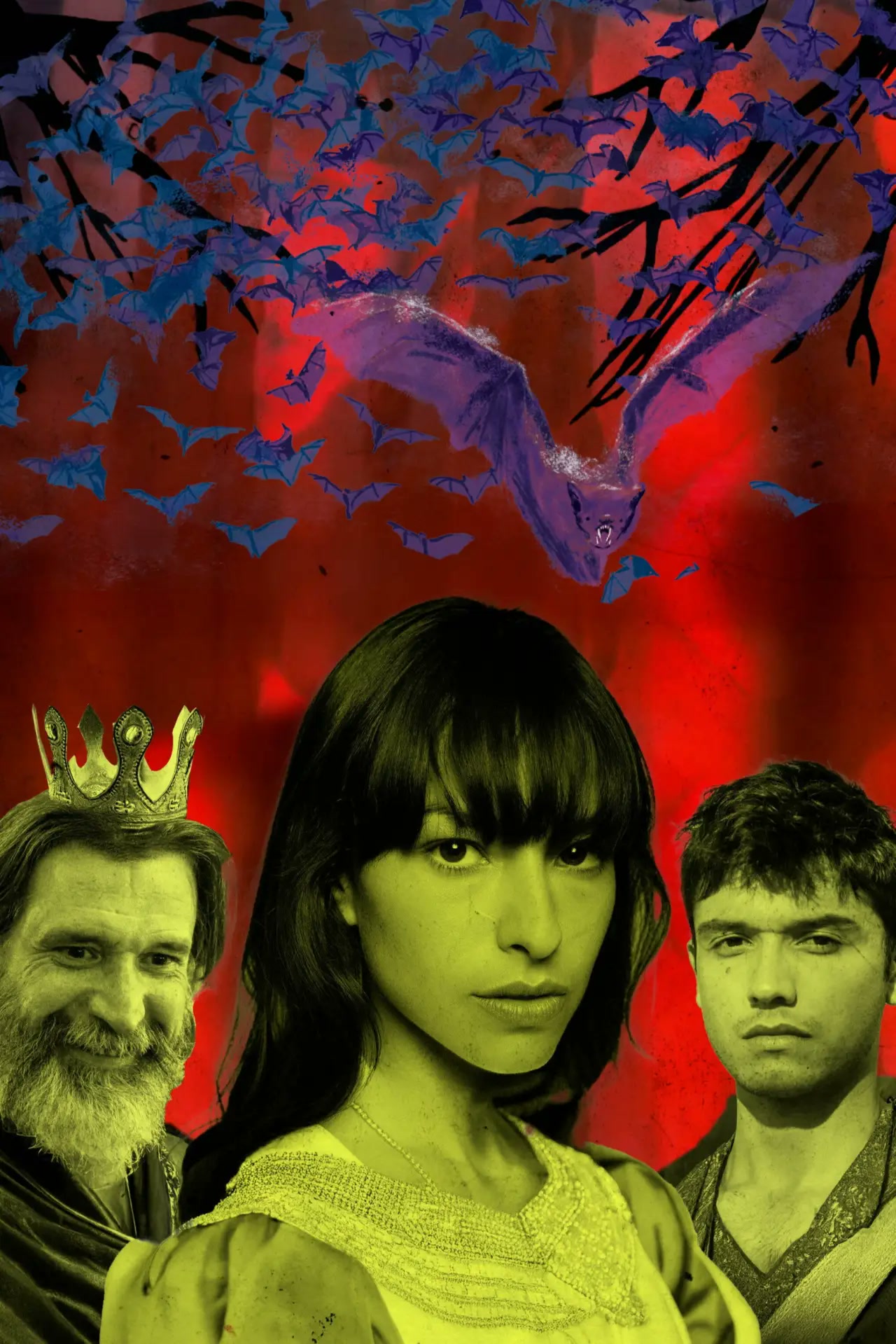
The setup reads like a fairy tale somebody has been chewing on for years. Diana (Antonia Giesen) is the princess of an ancient kingdom ruled by her father, King Arthur, who has outlawed love outright. When she falls for a young man named Lalo, the king does what kings do and banishes him. Diana finds an old bracelet, learns it can carry her between worlds, and goes looking. What she turns up along the way is that her father has been steering her choices the whole time. Warning beyond this point there are spoilers for “Donkey Princess” and the world-hopping structure the trailer lays out.
Most trailers burn their run time convincing you the magic is real. This one spends it showing you the wires.”
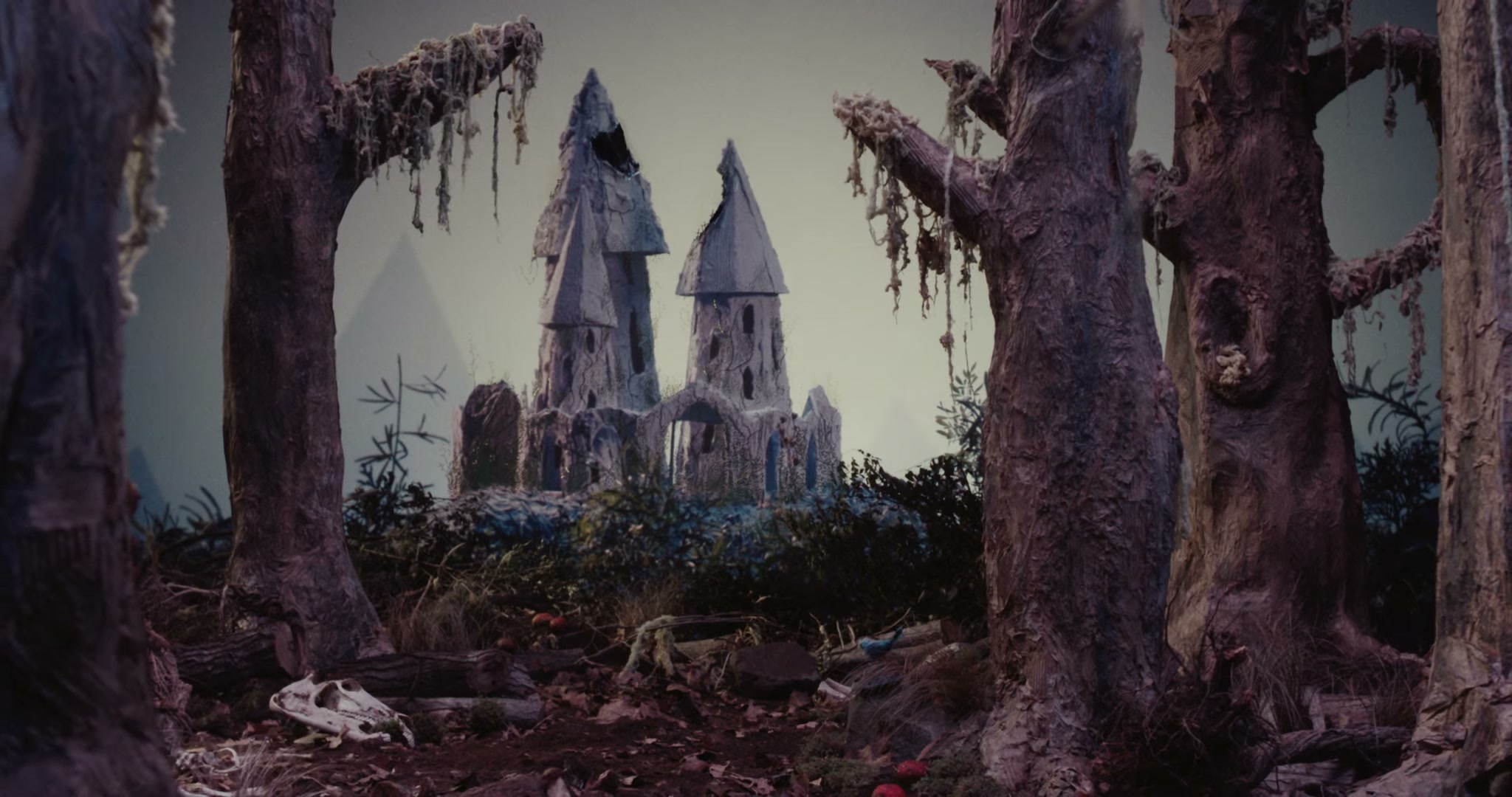
It opens on black, then a castle, two crooked spires against a sky the colour of pond water, foliage crowding the bottom of the frame. Nine seconds in, a gold bracelet set with a green stone sits in open flame while a pair of tongs works at it. Then a cut so tight you get nothing but an open mouth filling the screen. A voice arrives over the top doing full old-school trailer narration, the kind that went out of fashion decades ago: in a kingdom where love was forbidden, a princess was never allowed to love.
What follows is courtly and a little sickly. A couple kiss in front of a painted backdrop. A donkey stands in a stone chamber under a leaded window, lit by candles, waiting like it has been there some time. Diana lies back on an embroidered bed, turning something over in her hands and smiling at it. We cut to a bearded man in a dark green robe with a heavy chain at his throat, and the subtitle hands us the first line of dialogue in the entire cut: “It’s gorgeous. I love it.” The narrator, meanwhile, is describing a king who loved so much he forgot what love was for.
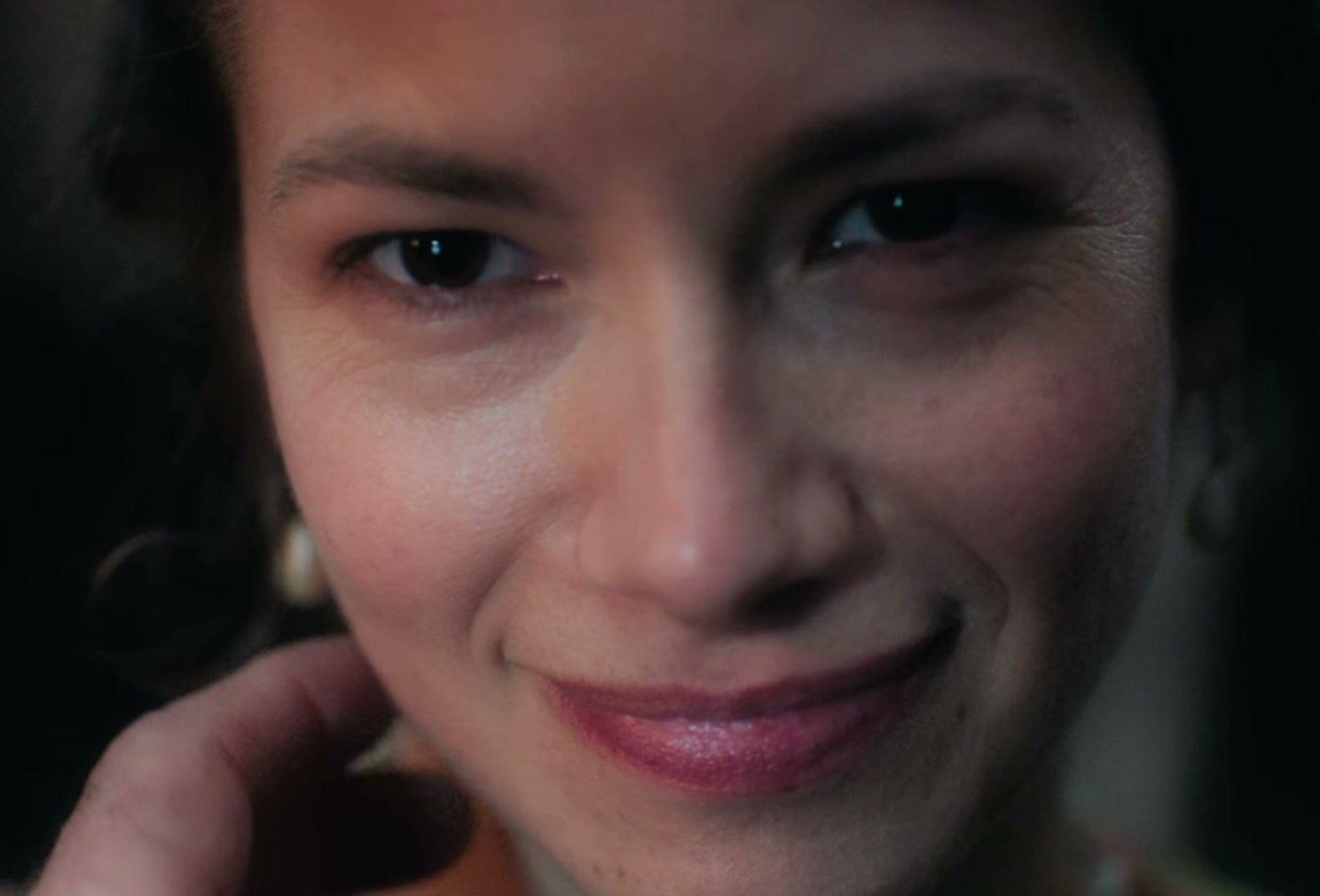
Around the thirty-seven-second mark the trailer stops behaving. Eight cuts land in under a single second, a lit candle against flat chroma green, a sparkler burning in blackness, the candle again, the sparkler again, a pink rose against that same unkeyed green. It plays like a projector jam. Out the other side comes Diana screaming in extreme close-up, and then Diana standing alone in a corridor washed in teal, wearing a striped top and shorts that belong to no fairy tale anywhere. She has left the kingdom. She is somewhere modern, and she is small in the frame.
From there the film starts flipping genres the way its directors promised it would. “Diana travels through parallel worlds where each universe transforms the film’s genre,” the pair write in their Locarno note. “The film brings this constant mutation of realities into live action, where fantasy reshapes everything.” The trailer takes them at their word. A figure in a plush green and orange mascot suit throws its arms up in a cave lit magenta. A still life of dried flowers sits on a shelf in the gloom. Diana turns up outdoors in a red athletic tank and a headscarf, squinting against dry grass and rock. A small figure burns down to smoke in the dark.
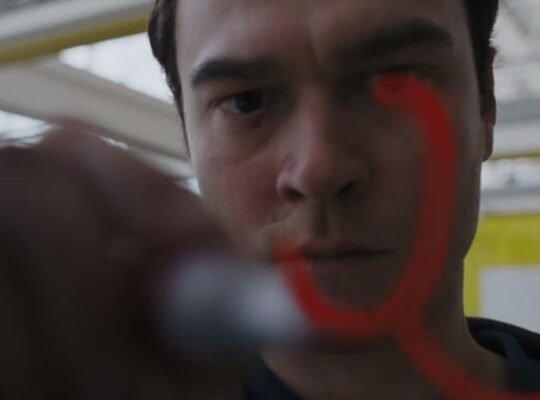
The second piece of dialogue is the one that matters. Back on the embroidered bed, somebody warns her, “You need to be really careful with it.” Her answer runs three words and contains the entire film: “Careful of what?” The narrator picks the thread up, an ancient bracelet, a forgotten power, a world beyond the horizon where every wish comes true, and the images go properly loose. A woman with slicked hair and a slash of red paint across one eye stares down a green screen. A hand with red nails lifts a white bowl of something red. Sand shifts over a shape buried underneath it.
Then it sprints. A cockpit built out of toys and lasers. A wolf’s head snarling in red light, matted and practical and close enough to count the teeth. Legs walking through mud in near-total darkness. The castle from the opening comes back, and this time we see it plainly for what it is: a model on a built set, ringed by handmade trees with moss hanging off them, animal skulls scattered across the floor, a painted backdrop behind it carrying the shadow of a spire. The film shows you its own trick barely a minute after using it on you, and somehow that makes the first version better rather than worse.
A crowned couple raise glasses in a grotto and a subtitle offers a cheerful “Cheers!” A red landscape vents a plume of pale smoke. And then the donkey flies, puppeteers and all. A torchlit crypt. A bed frame burning down. Hand-lettered white text drops over the images, scrawled rather than typeset: a film by León and Cociña.
The last stretch is the pitch. A tableau of costumed figures posed in a painted garden, pink spires behind them, a fish caught mid-leap, a storybook illustration rebuilt at human scale. A crowd of villagers in wide-brimmed hats pressed shoulder to shoulder with a white donkey among them. The title lands in rough red paint, “Donkey Princess,” and the narrator signs off calling it a motion picture fantasy, which is precisely the register of a 1970s one-sheet. The final image before the credits is a pink rose with a living human eye set in the middle of it, looking off to one side.
A few things the trailer never says out loud. The score comes from Jean-Benoît Dunckel, half of Air, the man behind “Moon Safari” and Sofia Coppola’s “The Virgin Suicides” and a César nominee for “Summer of 85.” The film runs 90 minutes in Spanish and is a five-country co-production stitched together across Chile, France, Uruguay, the Netherlands and Germany. Alejandra Moffat co-wrote with the directors, Benjamín Echazarreta shot it, and Catalina Vergara produced. The source is “Donkeyskin,” the Charles Perrault tale Jacques Demy turned into a Catherine Deneuve musical in 1970, which tells you exactly how high León and Cociña have set the bar for themselves. Bendita Film Sales is handling it internationally, and no distribution deal has been announced.
Here is the honest question hanging over it. Showing the seams is a real artistic position, and these two have earned the right to hold it. But a trailer is ninety seconds and a feature is ninety minutes, and the difference between a film that exposes its own machinery and a film that is merely pleased with itself for doing so is a line you cannot see from the outside. Locarno’s competition jury gets first crack at telling us which side this lands on. Our money, for what it is worth, is on the pair who made a house out of wet paint and made it crawl.
What Do You Think? Is leaving the green screen and the puppeteers in the frame a confident move from a duo who have earned it, or a joke that wears thin long before the credits? Which of the worlds glimpsed in that trailer do you most want the film to sit inside for a while: the mascot cave, the toy cockpit or the modern corridor Diana washes up in? And does a fairy tale about a father quietly steering his daughter’s every decision hit differently coming from the same pair who made “The Wolf House”?
See you on the next binge!