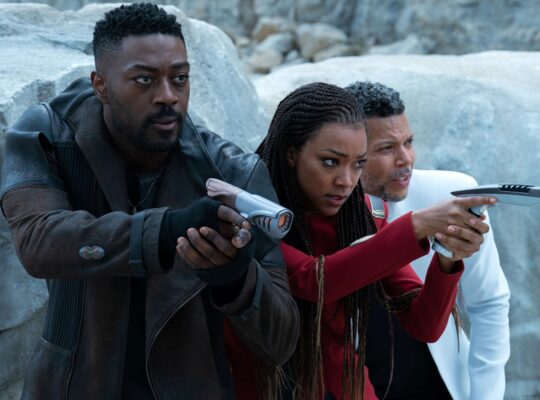
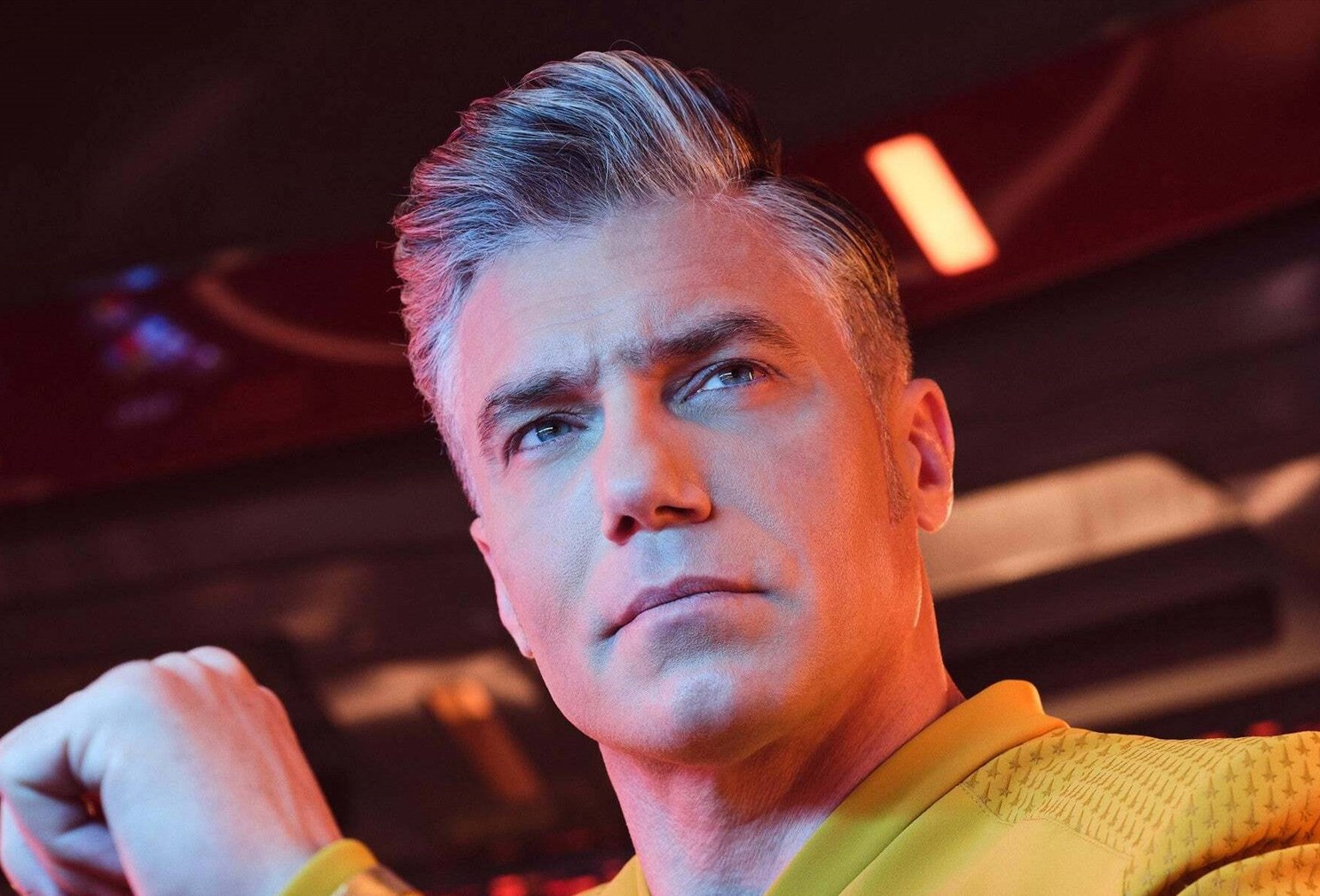
Star Trek has tried a lot of things in sixty years. It had not, until last Thursday, asked its first officer to stun a Tyrannosaurus rex. “Valles Marineris” opens Season 4 of “Strange New Worlds” by throwing the Enterprise 65 million years into the past, dropping half the bridge crew into the Cretaceous, and then quietly explaining that everything you know about how life on Earth got its shot happened because Christopher Pike (Anson Mount) decided not to act. It is a ludicrous hour of television. It is also, in stretches, a genuinely good one, and the gap between those two facts is the whole story of this premiere.
The housekeeping first, because Paramount+ changed the shape of things. Season 4 arrived as a single episode on July 23, not the three-episode dump of Season 1 or the two-parter that opened Season 3. Ten episodes, weekly on Thursdays, running to a finale on September 24. Chris Fisher directs, with Akiva Goldsman and Henry Alonso Myers sharing the teleplay. That weekly cadence matters more than it sounds, because this is an episode built like classic Trek, a self-contained adventure with a moral trap at the center, and it would have been buried if it dropped alongside two others.
We open on downtime. Pike is on a desert planet decompressing after six straight missions, and Una Chin-Riley (Rebecca Romijn) is not buying the vacation. She reads it as avoidance, and what he is avoiding is grief over losing Marie Batel (Melanie Scrofano). A new Vulcan cadet, A’Sha (Bianca Nugara), joins the crew around the same time, written as a colder read on Vulcan reserve than Spock (Ethan Peck) has ever been, a useful contrast the episode sets up and then mostly parks for later. Warning beyond this point there are spoilers for the “Strange New Worlds” Season 4 premiere, including the ending, the fate of an entire alien species, and the episode’s rewrite of how the dinosaurs died.
It is a ludicrous hour of television. It is also, in stretches, a genuinely good one, and the gap between those two facts is the whole story of this premiere.”
Then the plot arrives, hard. The Enterprise is tracking a Category 10 interstellar storm when it picks up a distress signal, and Pike takes the ship in, a call one reviewer flatly labeled reckless, and honestly, yes. The storm strips the ship of power and weapons and flings it 65 million years backward into Earth’s own solar system. Spock does the math and confirms the number, which is the moment the episode tips its hand about where this is going for anyone who paid attention in a science class.
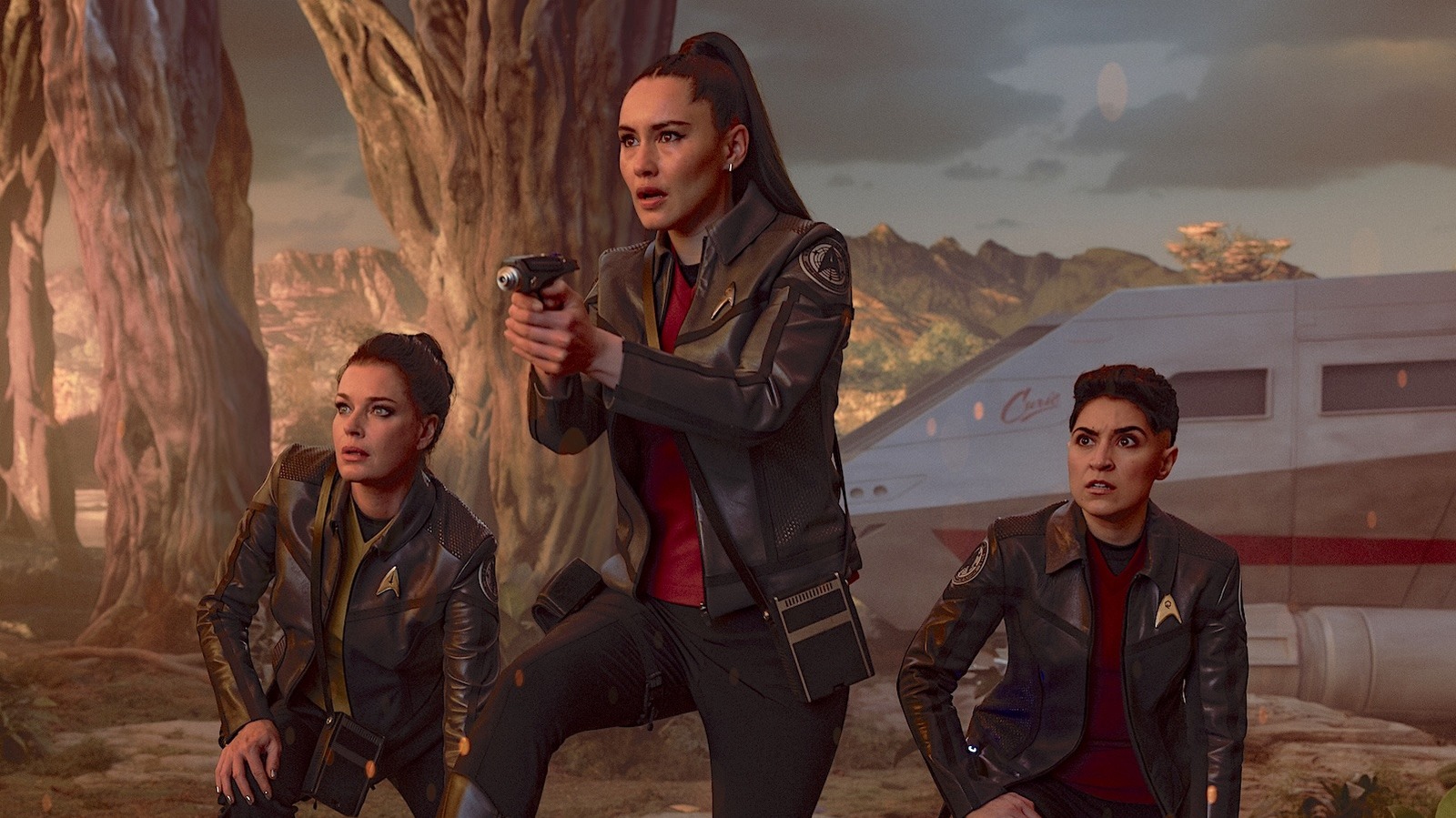
From there it splits. One team takes a shuttle down to prehistoric Earth hunting iridium to patch the ship, and this is the fun half: Una stuns a T-rex, and La’an Noonien-Singh (Christina Chong) ends up in a scrap with velociraptors and punches one square in the face. She breaks her hand doing it. She does not feel a thing. That detail is the episode’s quietest and best piece of business, and the show knows it, because it comes back to it at the end.
The other half is where the episode earns its title. Pike leads a landing party alongside Joseph M’Benga (Babs Olusanmokun) and runs into a Martian civilization, an actual, thriving one, on a Mars that still has an atmosphere and an ocean’s worth of ambition. They are at war with a species called the Dol’drm, described as mindless and invasive, and their military leader Commander Cassell (Saffron Burrows) is the kind of antagonist this show does well: not evil, just certain. She claims salvage rights over the crippled Enterprise and takes its antimatter fuel cell, intending to convert it into a weapon capable of ending the Dol’drm homeworld outright.
Pike tells her the truth. He is from the future, this will echo forward, do not do this. Cassell accuses him of dishonesty and delivers the line the episode is built around: “We live now, not in the future.” It is a good line because it is a good argument. She has a war on and a species at her throat, and a stranger in a jumpsuit is asking her to accept consequences she will never live to see.
So Pike has the trap. He can intercept the weapon and stop what is functionally a genocide, or he can hold to the Temporal Prime Directive and let 65 million years of history unfold as it already has. He chooses not to intervene. The weapon fires. The Dol’drm homeworld is destroyed, and here is where “Valles Marineris” goes for broke: that debris becomes the asteroid belt sitting between Mars and Jupiter right now. The blast wave knocks Mars out of its orbit, which is why the Mars we know is a dead rock instead of the living world Pike just stood on. And one fragment keeps traveling until it hits Earth, the impact that ends the dinosaurs and opens the door for mammals, and eventually for the species flying the ship. The Enterprise rides the shockwave home.
It is a closed loop. Pike’s refusal to act was always the cause of the future he came from, which means he was never choosing at all. That is the swing, and it is where reviewers split hardest. The AV Club argued the structure “robs the episode of stakes,” and that criticism lands: a moral dilemma stops being one the second the script confirms only one outcome was ever possible. Den of Geek was warmer, calling the hour “a determined return to basics” while conceding the paradox “makes almost zero sense if you think about its specifics for more than five seconds.” TrekCore, which liked it, still found it “a little over-stuffed” and wanted “more dinosaurs. More ethical debates.” Our read sits close to TrekCore’s. The episode is trying to hold an adventure romp and a genocide in the same hand, and those two halves never fully shake hands. The AV Club put it plainly: they “never quite cohere.”
What saves it is the last ten minutes. Back in the present, Pike is offered a promotion to Commodore, and he turns it down, telling the admiral that someone aboard his ship has earned it more, and handing it to Una. Every recap describes that as a promotion to Commander, which is a little strange given Una already runs the ship as first officer, and nobody has clarified whether this is a formal rank bump or a command-track designation. Worth watching the scene yourself rather than trusting the shorthand. The crew then sits around trading dinosaur stories, which is exactly the note this show is best at. And La’an sits with her broken hand and the fact that it does not hurt, because her Augment lineage is starting to assert itself, and she is afraid of what that means. “I broke my hand and I don’t feel any pain,” she says. That is the season arc, planted cleanly.
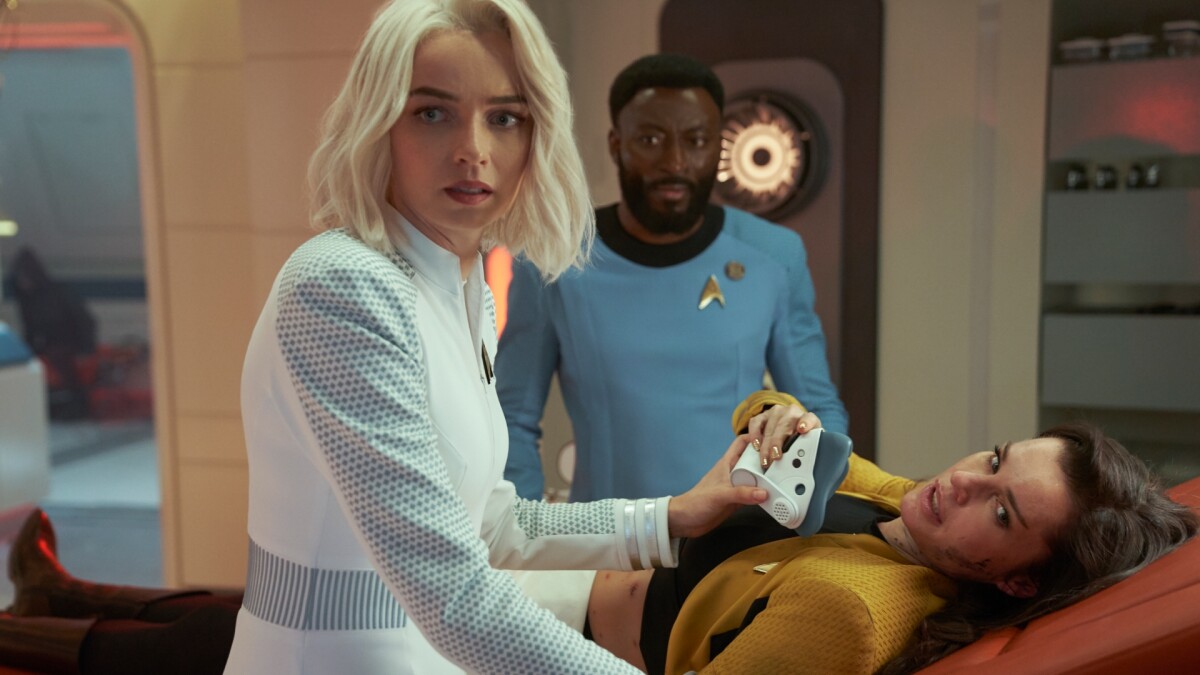
If you are hoping this is a full-ensemble hour, adjust. Spock gets little beyond confirming the time displacement. Erica Ortegas (Melissa Navia) rides along on the away team, and one reviewer noted friction developing between her and Montgomery Scott (Martin Quinn), though that detail turned up in a single write-up and nowhere else, so treat it as a thread to watch rather than a confirmed development. Nyota Uhura (Celia Rose Gooding), Christine Chapel (Jess Bush) and James T. Kirk (Paul Wesley) are aboard, but this is not their hour, and the coverage reflects that. Carol Kane’s Pelia does get to revive the show’s running Doctor Who gag, which remains funnier than it has any right to be.
One honest gap, and we would rather flag it than paper over it. The premiere leans on Pike grieving Batel, but Season 3 did not end on a cliffhanger: it closed with Batel, wielding new abilities, generating a reality in which she and Pike beat the parasitic Vezda, married, settled in Mojave and raised a daughter, before the finale pivoted to Korby’s map of uncharted space and a fresh five-year mission. How the show gets from that ending to a Pike in mourning is not something any recap we found spells out. Either the premiere handles it in a beat the write-ups skipped, or the season intends to take its time. We are not going to invent the connective tissue.
Context sharpens all of this. Season 4 is the penultimate run: Paramount+ has confirmed a fifth and final season of six episodes, against the ten this one carries. Goldsman, Myers and Alex Kurtzman framed it as finishing on their own terms: “We’re deeply grateful to Paramount+ for the chance to complete our five-season mission, just as we envisioned it, alongside our extraordinary cast and crew.” Goldsman has described that last run as “a six-episode goodbye,” tonally singular rather than genre-hopping, a meditation on farewell. Which reframes a premiere like this one. If the ending is a sustained elegy, then a dinosaur-punching, planet-cracking adventure of the week is the show stretching its legs while it still can.
The verdict, then, is split down the middle and comfortable there. “Valles Marineris” is overloaded, its central dilemma is defused by its own structure, and its two storylines are barely on speaking terms. It is also confident, funny, willing to look foolish, and anchored by a Pike who makes a genuinely cold decision and has to live with it even knowing it was never his to make. ScreenRant called the season “more episodic and endearingly chaotic than ever before.” That is the right description, and after three seasons of this show swinging between musicals and courtroom drama and body horror, chaos is not a complaint. Enterprise is back out there. It just took the long way around.
What Do You Think? Does a predestination loop wreck the episode’s moral stakes, or does watching Pike choose correctly while knowing he had no choice make it sadder and better? Is tying the dinosaur extinction and the asteroid belt directly into Trek canon a fun bit of world-building or a swing too big for a franchise that already has enough continuity to manage? And with La’an’s Augment DNA waking up in the premiere’s quietest scene, is the show setting her up as the emotional center of its final two seasons?
Catch up properly: every Star Trek series and movie in chronological order on our Timeline Hub’s Star Trek timeline.
See you on the next binge!