The red band card at the top of Adult Swim’s new trailer reads “The following trailer may cause extreme excitement. Viewer discretion is advised,” which is a joke, and then the next ninety seconds spend a lot of effort proving it was not much of one. “Get Jiro” premieres October 3rd at midnight, and it is an adaptation of a graphic novel Anthony Bourdain co-wrote in 2012 about a sushi chef who kills people for ordering badly. Eight years after his death, Bourdain has a new show, and it opens by cutting a man’s head off at a sushi counter.
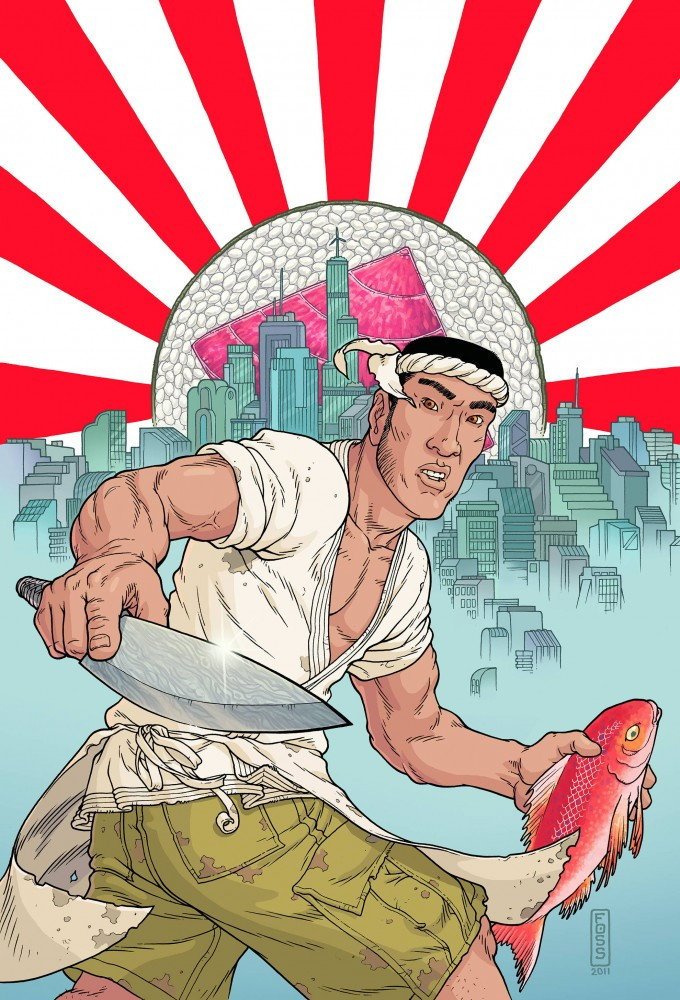
If you never read the book, the premise is worth having up front, because the trailer assumes you have. “Get Jiro!” was published by DC’s Vertigo imprint in 2012, written by Bourdain with the novelist Joel Rose and drawn by Langdon Foss, and it went to number one on the New York Times bestseller list. It is set in a near future Los Angeles where master chefs run the city like crime bosses and diners genuinely kill for a table. Warning beyond this point there are spoilers for the “Get Jiro” trailer, including the scene it builds its whole punchline around.
Eight years after his death, Bourdain has a new show, and it opens by cutting a man’s head off at a sushi counter.”
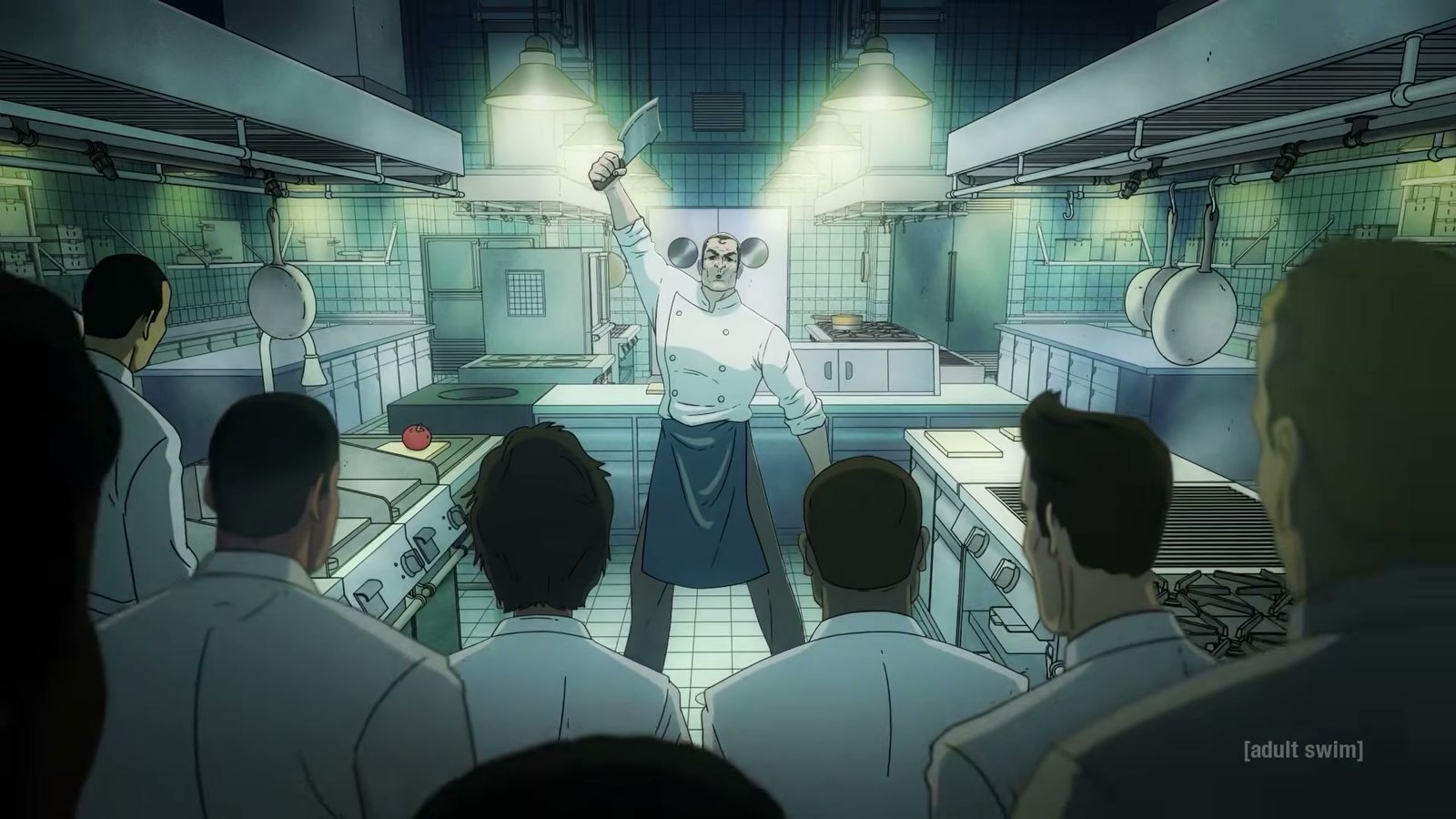
The trailer is narrated the whole way through, in the flat cadence of a movie voice from about 1994, and the first line sets the register. “They say in the restaurant business that competition is healthy. Tell that to your fellow chefs bleeding out in the street.” Under it, a hand closes around a meat tenderiser in a tiled kitchen, then a cleaver, then a second cleaver held up under the pass lights. It is a full ten seconds of kitchen tools being picked up like weapons before a single person is hurt, and the animation lingers on the metal the way a Western lingers on a holster.
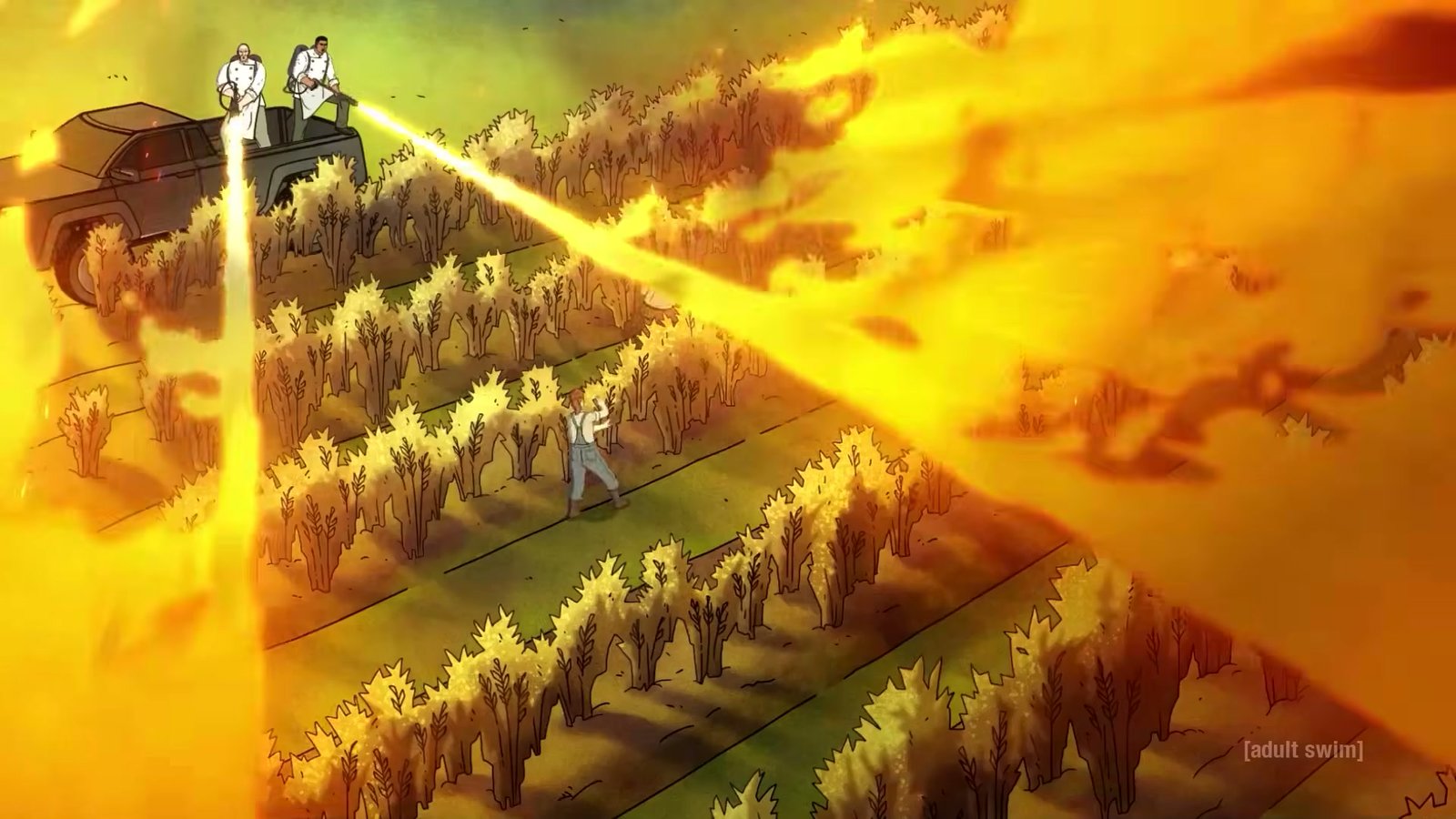
Then the war. “The war between rival chefs Bob and Rose is bloodier than your usual food fight.” A man leans out of a black car with a submachine gun and opens up on a restaurant terrace, and the next shot is bodies among the tables and diners scrambling over chairs. Bob and Rose get colour coded introductions that tell you everything about the show’s visual grammar: Bob washed in cold green, in chef whites, holding two pistols crossed at his chest, and Rose in hot orange red with her hair up and a revolver at her shoulder. “We won’t stop till there’s nothing left to kill,” one of them says, and the trailer cuts to men with flamethrowers walking a rice field and burning it row by row.
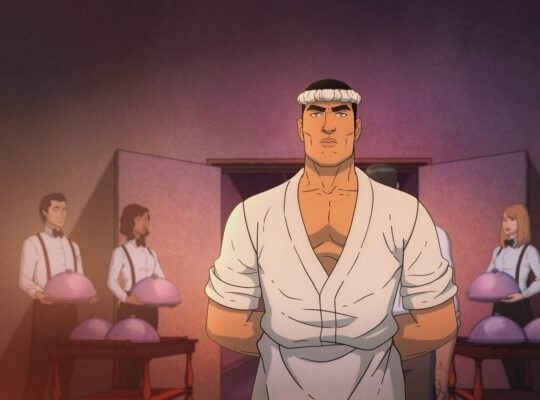
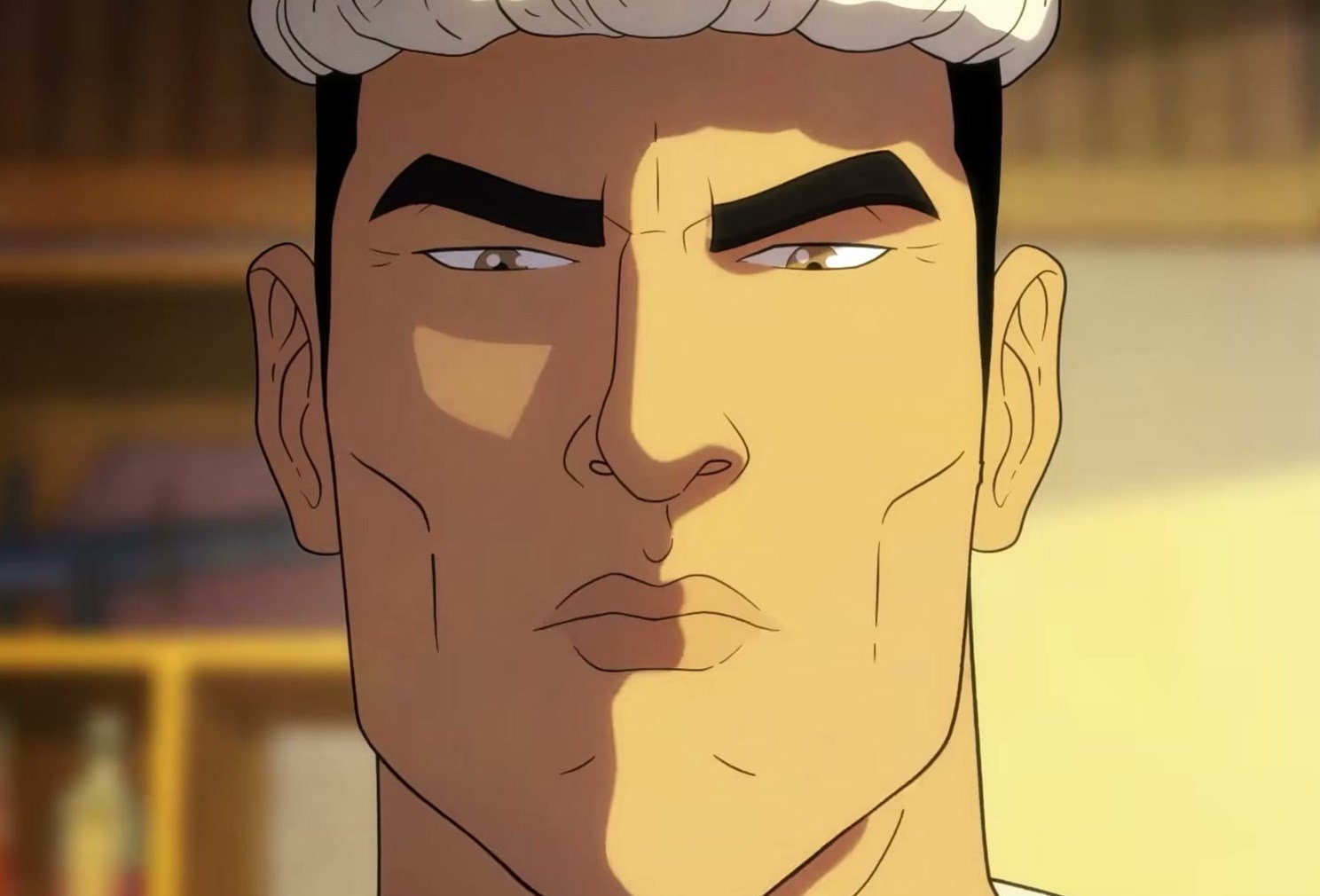
Jiro (Brian Tee) arrives as the third thing neither of them planned for. “But they’ve never crossed knives with anyone like Jiro. That’s the sushi chef everyone’s been talking about. A fresh taste with a mysterious past. He’ll have to prove himself if he wants a seat at the table.” He is drawn heavier and stiller than everybody else on screen, and the trailer keeps returning to his face doing nothing at all while the frame around him falls apart. It is a good piece of character design. He looks less like an action hero than like the one adult in a room of people having a tantrum with knives.
Then it does the scene. A blond man in a suit sits at Jiro’s counter. The camera pushes into Jiro’s eyes and holds. The customer smiles, picks up a piece of nigiri with his chopsticks, and dunks it fish side down into a bowl of soy sauce. There is a single white arc across a black screen. The next frame is the man’s head leaving his shoulders against a wall of pink speed lines while blood sprays across the counter and the other diners recoil, and the narrator says, evenly, “No soy sauce.”
Readers of the book will have been waiting for exactly that, because it is the gag the whole thing was built on. In the graphic novel Jiro decapitates patrons who ask for a California roll or who stir wasabi into their soy sauce, and it functions as a joke about food snobbery taken to its literal end. What is interesting is that the show plays it completely straight. There is no wink, no comic sting, no cutaway. The trailer just shows you a beheading and moves on, which suggests the series understands the difference between a joke on the page and the same joke at twenty four frames a second.
Everything after that is escalation, and this is where the red band label earns itself. Somebody has an eye put out at close range with a kitchen tool. A man takes a cleaver to the face. A chef is pinned to a restaurant floor. There is a street strewn with bodies, a mechanical arm ending in a blade, and a man being force fed something yellow until his cheeks distend. It is not coy about any of it. If you are squeamish, this is a straightforward no, and the trailer is honest enough to tell you so in the first two seconds even while pretending to make a joke about it.
The best line is the smallest one. Somewhere in the last thirty seconds, over a shot of a chef looking out at a ruined dining room, a voice says “I hate brunch,” and it lands harder than any of the violence because it is unmistakably Bourdain. So is “This town is full of people who deserve to die,” and so is the exchange where somebody offers the old line that revenge is a dish best served cold and gets back, flatly, “No, but I’ll take it anyway.” That is a man who spent his career being funny about food and furious about the industry, and the trailer’s credit block says it plainly: “From Joel Rose and the late Anthony Bourdain comes a bloody tale of action and appetite.”
The card at the end reads SERIES PREMIERES OCTOBER 3RD AT MIDNIGHT, then NEXT DAY ON HBO MAX. The slot is Toonami, which is a deliberate choice: Adult Swim is filing a DC adaptation next to its anime block rather than beside its comedies, and the art direction backs that up. Titus Welliver, Alison Pill and Justin Kirk fill out the voice cast, Brian Gatewood and Alessandro Tanaka developed it, and it comes from Warner Bros. Animation and DC Studios. Then Adult Swim does something you almost never see a network do at the end of a trailer. It hands the screen to DC for a plain promo card reading READ WHERE IT ALL BEGAN, pointing viewers at a comic shop. A ten episode season out of a single 2012 graphic novel is a lot of stretching, and that card reads like a network quietly telling you where to find the original if the adaptation loses its nerve. On the evidence of ninety seconds, losing its nerve is not the problem this show is going to have.
What Do You Think? Does playing the soy sauce beheading completely straight make it funnier than winking at it would have, or does it lose the satire that made the book work? Can a single graphic novel carry ten episodes, or is this the kind of adaptation that runs out of book by the halfway mark? And is there something strange about a posthumous Anthony Bourdain project being the most violent thing on television this autumn, or is that exactly the joke he would have wanted?
See you on the next binge!